Showing posts with label Cemeteries in Tiberias. Show all posts

Saturday, February 26, 2011

Wednesday, January 26, 2011

The Kever of the Amshinover Rebbe in Tiberias

B"H

One of my blog readers asked me about the grave of the Amshinover Rebbe buried in Tiberias (Tveryia). I must admit that I don't know much about Chassidut Amshinov and would love to hear more details. When I lived in Jerusalem, I never made it to Bait Vagan where the present Rebbe lives. A while ago I was ready to go to his Tish but an Amshinover Chassid told me that the Rebbe was sick. 

Here are the photos from the Amshinover Rebbe buried on the Tiberias cemetery. His Kever is fenced and not too far away from the entrance. However, the grave is, at least, 100m far away from the section where some Baal Shem Tov students as well as Rabbi Menachem Mendel of Vitebsk is buried.


Two women are buried right next to the Rebbe's grave. However, outside the fence to the left. I am mentioning this as the blog reader was interested in "Who is buried next to the Rebbe ?"


Rabbanit Ayala Shechtel buried near the Amshinover Rebbe. I have never heard about her and the location of her grave doesn't mean that she must be somehow related to the Rebbe.


Copyright / Photos: Miriam Woelke

Monday, January 24, 2011

The Grave of Rabbi Mordechai of Bilgoraj


Rabbi Mordechai of Bilgoraj


B"H

Rabbi Mordechai Rokeach (1902 - 1949) was the father of the present Belzer Rebbe Yissachar Dov Rokeach. By the way, Rebbe Yissachar Dov looks very similar to his father.

The half brother of Rabbi Mordechai was the famous Belzer Rebbe Aharon Rokeach who escaped had escaped the Nazis and finally made it to Israel. When he died, Rabbi Mordechai's son Yissachar Dov was the only one in line to become the next Rebbe. All other close family members were killed during the Holocaust. 
Rebbe Yissachar Dov only became Rebbe years later, as he was still a child when his uncle Aharon passed away. He, later on, married the daughter of the Vishnitzer Rebbe from Bnei Brak. 

Rabbi Mordechai of Bilgoraj is buried in Tiberias and here are a few photos of his Kever. I took these pictures today


Copyright / Photos: Miriam Woelke

Saturday, December 11, 2010

Tiberias Cemetery: Graves of Rabbi Menachem Mendel of Vitebsk & the Amshinover Rebbe


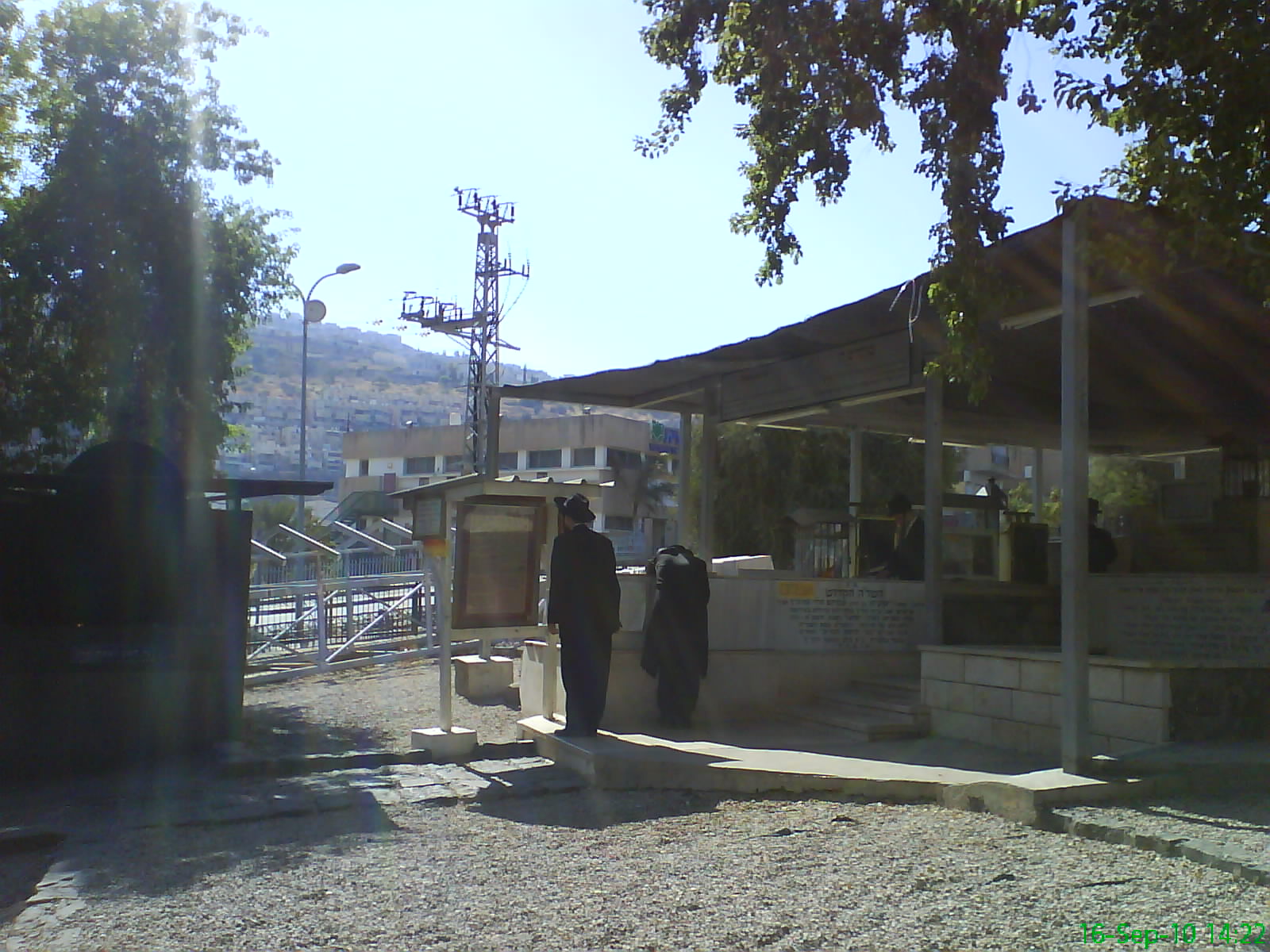
The Tiberias cemetery includes many graves of famous Rabbis.
The Rambam, Rabbi Akivah and Rabbi Me'ir Baal HaNess are not buried on the cemetery but somewhere else in town. However, many other famous Rabbi are.


The seperation (Mechitzah) between men and women leading to the graves of the students of the Baal Shem Tov as well as to Rabbi Menachem Mendel of Vitebsk.


Ancient graves


Grave of the Amshinover Rebbe Yitzchak Kalish.


Rabbi Menachem Mendel of Vitebsk


Grave of Rabbi Avraham Abulafia


Photos: Miriam Woelke

Thursday, December 2, 2010

How about getting older ?

B"H

When I see some of the really old chassidic Rebbes I am always amazed how they still dance and jump around. Of course, you can see their age and not everything is asit used to be when they were younger but still ...

I am still busy writing the book about a former Tiberias celebrity. However, today know one seems to remember the person and, as I said before, then I start thinking about what fame really means. It means nothing. In the end we all have to die and then G - d won't judge us according to our amount of Facebook friends but according to our Mitzvot and deeds.

I think it was in the "Tikkunei HaZohar" where I once read that the Cherubim (angels with children's faces) are guarding the entrance to Gan Eden (Paradise). Usually people think that those Cherubim are such nice creatures because of their children's face but, in fact, they are not. They have the power to destroy and it says in the "Tikkunei HaZohar" that these Cherubim look into your soul when you are standing in front of the gate.

Whatever that really means, one thing is for sure: Nothing is that easy and especially these days, I am thinking a lot aout the subject. Getting older and then ? How do you deal with an advanced age when you are not called Noach and become 900 and something years old ?

I went to an old age home this morning because I am doing research for my book. As soon as I entered, I became aware of the hospital smell. Staff and visitors were nice and talked to me. Afterwards I went to the local cemetery looking for the grave of a former mayor. Walking around on our local cemetery is not that easy, as, many times, you only have a few centimeters walking space between the graves.

Towards the end of the day, I phoned the "Chevrat Kadisha" near Tel Aviv in order to find out about another grave. They invited me to come to their office. But not after 1.30pm because it is Chanukkah and the Haredim working there want to go home early.


At the Tiberias cemetery.

Photo: Miriam Woelke


One more cemetery next week and I hope this is it. 

I was so busy today that I didn't even notice the news about the huge fire catastrophe on the Carmel near Haifa. Someone told me later on that I should be dealing with the world which is alive and not with the dead.:-)

Wednesday, December 1, 2010

A Kosher Street for Cohanim in Tiberias

B"H

The descendants of Aharon (brother of Moshe) are "Cohanim - Temple Priests" and thus underlying special halachical purity laws. One rule is that a Cohen is not allowed to come into touch with a dead corpse. The result is that it is more than complicated for him to visit a cemetery and he needs to take special precautions.


Tiberias, the town at the Sea of Galilee (Kinneret) is now building an entire street leading from Hayarden Street (at the Central Bus Station) a few meters around the corner to the grave of the Rambam (Maimonides, 1135 - 1204).


Tiberias was built on ancient cemeteries. Not a cemetery in a real sense; however, even more than 2000 years ago, Jews and before the Canaanites, used to bury their people in and around the area.


The grave of the Rambam in Tiberias.


The halachic way of building a new road across the Rambam's kever. A haredi Rabbi is always watching the construction workers.

How is such a halachic street being built?
Thick parts of concrete are being put in a certain way on top of the possible ancient graves. Not in order to destroy but to cover them.


I made these photos on November 29, 2010:
Miriam Woelke


Links:


Friday, November 26, 2010

Shabbat Shalom

B"H

I met the Tiberias Chabad Shaliach a few days ago, and he was convinced that I was meant to me him. Call it "Divine Providence". 
Well, I have nothing against it because, so far, I haven't really done too much in Tiberias in a frum community sense. I have friends in Zfat and mostly stayed there over Shabbat but this is a mistake when you want to get settled about 40km down south in Tiberias. 

Of course, the Shaliach invited me for Shabbat. Who would be surprised when it is a Chabad Shaliach.:-) He also told me that the Chabad communities in Tiberias is much smaller than its counterpart in Zfat. About twenty families have settled here and their main center is in Rashi Street. Further chassidic groups keep on buying real estate. Vishnitz, the Kaliver Rebbe has a house here and the Toldot Aharon may be not too far away anymore.

Yesterday I went to the famous Tiberias cemetery (photos will follow a little later). Many great chassidic Rabbis are buried there. Rabbi Avraham Abulafia, Rabbi Chaim Abulafia, Rabbi Menachem Mendel of Vitebsk and plenty students of the Baal Shem Tov. In order to get the best pictures, I used the male alleyway to the graves of the Baal Shem Tov students. An alleyway with a Mechitzah (gender separation fence) is leading into this particular section of the cemetery. About twenty minutes after I had left the male section, a prominent Rabbi with a Yeruslami hat showed up with his three or four followers. I was lucky they hadn't caught me in using the male alleyway.:-))))  

"Shabbat Shalom - Gut Schabbes" to everyone !

Tuesday, November 2, 2010

Graves of Rabbi Chananel and Rabbi Yochanan in Tiberias

B"H

When you take a walk through Tiberias (in northern Israel, at the Sea of Galilee / Kinneret) it is nothing unusual that you suddenly run into ancient graves. Ancient famous graves in the middle of the city. This happened to me last Thursday when I took a look around in order to get to know the city. Behind a shopping center and in front of a huge housing complex I saw this:


The graves of some Amoraim such as Rabbi Chananel or Rabbi Yochanan.


Photos: Miriam Woelke

Sunday, October 24, 2010

The graves of the Rambam and Rabbi Yochanan ben Zakkai

B"H

Last Thursday, I went to the grave of the RAMBAM. I have done so quite a few times lately.

The RAMBAM (Maimonides, 1135 - 1204) in buried in Tiberias / northern Israel.


The grave of the Rambam in Tiberias / northern Israel.
The Mechitzah (separation between men and woman) goes right over the grave.
This is pretty new and I find it rather strange.


Memorial Candles


The grave of the famous Talmudic Rabbi Yochanan ben Zakkai near the gravesite of the Rambam.


Photos: Miriam Woelke


Further Link:

Why the RAMBAM is buried in Tiberias

Sunday, October 17, 2010

Ancient Graves in the Galilee


Part of the ancient cemetery in Zfat (Safed).

Photo: Miriam Woelke

B"H

The fascinating thing in northern Israel is that, anywhere you go, you stumble over ancient graves from Tannaim (Talmudic Rabbis) or other famous Jewish personalities and Rabbis. You walk around in downtown Tiberias and suddenly you see an ancient building with a blue rooftop or a marked cave. This is usually the sign for another ancient famous grave.

The same when you hike in the Meron area or elsewhere in the Galilee. I find it just an amazing !

Saturday, October 9, 2010

Why the RAMBAM is buried in Tiberias

B"H


In 1204, the Rambam (Maimonides) died in Egypt but he is buried in Tiberias (northern Israel). Despite some existing disputes about his grave, whether it is really in Tiberias or in Egypt, there are different stories about how his dead body ended up in Tiberias in order to bet buried there.


One story says that when the Rambam felt that he would soon pass away, he called his students together and asked them to put his dead body on a camel and just let it walk wherever it wanted. The students were supposed to follow the camel and bury the dead body of the Rambam where the camel stopped and didn't want to go any further.


And this is what happened: The Rambam passed away, the students put his dead body onto the back of a camel and the camel started walking. Somehow it walked up all the way to Safed (Zfat) and only stopped walking near the grave of Rabbi Yochanan ben Zakkai


This is one of the reasons why the Rambam is buried in Tiberias.


Walking up to the Rambam's grave in Tiberias.

Photo: Miriam Woelke


_________________________

Sources

The burial story itself:

Iggeret Rabbi Yosef Sofer from Zfat (Safed)

Additional Source:

"Mekomot Kedushim ve'Kivrei Zaddikim
be'Galil - מקומות קדושים וקברי צדיקים בגליל"

Monday, October 4, 2010

Was RACHEL the name of Rabbi Akivah's Wife ?

B"H

While staying in Tiberias about three weeks ago, I went to visit some famous Jewish graves. Not necessarily in order to pray so much at a grave of a Zaddik so that he may influence G - d or whatever some frum Jews consider as the purpose for praying at a Zaddik's grave. I am not too much into the "Zaddik - Righteous" issue and according to my opinion, one doesn't necessarily need to get to a grave in order to pray. However, I went to the Kever of the Rambam (Maimonides), of Rabbi Me'ir Ba'al HaNess and to the grave of Rachel. Not the Rachel from Bethlehem but Rabbi Akivah's wife buried in Tiberias !

Especially many Haredim I have spoken to refuse to believe that the present grave in Tiberias is really the grave of Rachel. There are plenty of controversies: 
Above the old Jewish cemetery we find an old Muslim cemetery and this is why nothing is certain. Despite that the Ishmaelim admitted that the daughter of Kalba Savua is buried there. Others claim that Rachel would be buried aside her husband Akivah and this is the reason why the present location of the grave must be wrong.
Rabbi Akivah is also buried in Tiberias but at a totally different spot.

Regarding all kinds of disputes, I am going through a few sources these day although it is impossible to find out the truth in our days. Furthermore, I made some photos and I am going to publish them as well.

The Babylonian Talmud (e.g. Masechet Nedarim 50a) always refers to Rachel as "The Daughter of Kalba Savua" and nowhere we find the name RACHEL mentioned. When it comes to Rabbi Akivah and his wife, no female name is given and we only find the name RACHEL in much later Midrashic sources.

Not only that there is a doubt whether the present location of the grave may be false, but there is another doubt whether Rabbi Akivah's wife was named RACHEL.

Monday, September 20, 2010

The grave of the RAMBAM in Tiberias, Part 1

B"H

Last Thursday I also went to the grave of the RAMBAM (Maimonides, 1135 - 1204) and here are the photos. Wikipedia mentions that there is a discussion about whether the grave in Tiberias is really the one of the Rambam or if her was buried in Egypt where he died.


"Welcome to the grave of the Rambam ! Please respect the holiness of this place !"


The Rambam's grave can be found in downtown Tiberias. Only a 5 minute walk away from the Central Bus Station. Before you enter the complex you have to pass a few souvenir stands (see above).


I don't know whose idea this was:
The 13 Principles of Faith hanging next to the toilet !


Walking up to the grave.


Before you get to the actual Rambam grave, to your left you can find further graves of very famous Rabbis. However, I will put those pictures into the blog a little later and first only concentrate on the Rambam himself.


The Mechitzah (separation between men and women) was pretty new to me. The last time I was there, the grave was accessible for anyone and we sat around the grave in a circle. Men and women together.


Photos: Miriam Woelke