Showing posts with label Halacha. Show all posts

Saturday, August 25, 2012

Giraffes are KOSHER but are we allowed to eat them ?

B"H

In Sefer Devarim (Deuteronomy), G - d gives us a list with all kinds of kosher animals including the conditions on how to determine a kosher animal. A week ago, we read Parashat RE’EH and it is there where we find the exact list: Sefer Devarim 14:5 lists a kosher animal called ZAMER which Rabbi Sa'adia Gaon as well as the RADAK identify as a GIRAFFE. So, a giraffe is a kosher animal but, the question is, whether we are allowed to eat it's meat. 

Giraffes are considered kosher because they have split hooves and chew their cud. As we all know, a pig, for instance, cannot be kosher, as it only has split hooves but does not chew its cud. In order to be regarded as a kosher animal, both conditions have to be fulfilled and not only one of them. 

There is an opinion that we still cannot eat the meat of a giraffe because a Shochet wouldn't know where exactly to schaecht the animal due to its long neck. This, however, seems to be a false rumour because the neck may be cut anywhere. 

The reason why Jews still do not eat the meat of a giraffe is a lack of tradition. It is simply not part of Jewish tradition to go into a store and buy some giraffe meat or does anyone of you know a Jew having put giraffe meat onto a grill ? 

Those of you who would like to have a deeper look into the subject should go to the  Site of Dr. Ari Zivotofsky. It actually is very interesting to learn more about the animals mentioned in the Torah and the Talmud. A topic we usually treat as a minor issue.
________________________________

Sources:

- Sefer Devarim, 14:5 

- Natan Slifkin: "Sacred Monsters", page 76

Tuesday, August 21, 2012

Changing location after making a Bracha

B"H 

Photo: Miriam Woelke

An interesting issue showing us that we Jews never stop learning. I don’t know about you but I have never thought about a cup of coffee, it’s Bracha (blessing) and me changing the location. However, I know about the topic from saying the Birkat HaMazon. When Benching, one should sit on this particular chair where he first said HaMotzi. 

There is a great site telling you all kinds of Halachot and the particular blessing issues. Lets say you are drinking a cup of coffee in your office and take your cup to a different location after making the Bracha at your office. Is the Bracha then still valid ? Generally speaking NO because a new location requires a new Bracha unless you may finish your cup of coffee in your car. There are exceptions you can look up HERE !

Monday, July 9, 2012

New Clothes during the Bejn HaMetzarim

B"H 

With yesterday's 17 Tammuz, the Jewish world has entered the three - week mourning period before Tisha be'Av. Those three weeks are referred to as BEJN HA'METZARIM but their task is not to make our lives miserable. Although we should remember the destruction of both Temples as well as the suffering of the Jerusalem population under the siege of the Babylonians and, later on, the Romans, our task is to do our own private CHESHBON NEFESH – Analyzing ourselves and how we relate to Mitzvot and G - d. Where are our mistakes and how can we slowly improve ourselves ?

Halacha commands us to follow certain laws during the Bejn HaMetzarim. One of those rules is that Jews don't get married until Tisha be'Av is over. Another rule is not to buy and to wear new clothes during those three weeks. Are we, at all, allowed buying or wearing new clothes during the Bejn HaMetzarim ? 

When we usually buy new clothes such as skirts, pants or shirts we say the "Sheyechiyanu" Bracha. However, we don't make Berachot on new shoes but some follow the custom symbolically marking the word AMALEK underneath their shoe. Like drawing the word with a finger. 

Nevertheless, are Jews allowed to buy and wear new clothes during the three weeks ?

The problem is not really the buying but wearing the new clothes. It says that one should refrain from wearing new clothes we usually make a blessing on. Underwear and socks don't need a Bracha and may be bought and worn during the three weeks. New shirts, pants or skirts may not be worn but can be bought. 
Remark: 

Some Rabbis even allow wearing new clothes until Rosh Chodesh Av !

Wednesday, May 30, 2012

May I re - use a postal stamp ?

B"H

Most of us know the situation: We are receiving a letter delivered by the postman and suddenly we notice that the post office forgot to put a postmark over the stamp. Are we then allowed to re - use the stamp ? 

Halacha tells us not to re - use the stamp, as this would be GNIVAH (Theft). The first person paying for the stamp and sending out the letter was paying for the delivery service carried out by the post office. Thus the post office received the money and sent out the postman. Meaning, the service is paid for and if you want to send your own personal letter by re - using the stamp, you would be stealing from the post office. Therefore it is not allowed to re - use such a stamp.

Wednesday, March 28, 2012

Halacha: Downloading Music and Movies

B”H 

We all know the situation: The Internet provides us with free music and movies. Why then buy the latest pop songs when almost everything is available online ? And, how does the Halacha refer to someone copying music or movies ? Is this allowed ? 

According to Rabbi Moshe Feinstein, copying music, movies, art, etc. is prohibited. We are not allowed copying other people’s creations because they loose money. (See Igrot Moshe, Orach Chaim, Vol. 4 Siman 40:19). 

In addition to that, we are guilty of theft. Especially when it comes to copyright claims.

Wednesday, March 21, 2012

No words in a Restroom

B"H

Jews are not allowed to speak in a restroom. It happens many times that someone is busy in a restroom while a second person is looking for him. In this case, the first person knocks on the inside door of the restroom so that the second person is able to hear him and thus knows where he is.

Furthermore, the Talmud teaches us that no one should use the word SHALOM in a restroom, as SHALOM is one of G - d's names.

Saturday, November 19, 2011

May a potential customer taste food before purchase ?

B”H 

According to the worldly law it may be a problem and seen as theft: A person is passing a market stand and grabs and olive, grape, or any fruit and eats it. He eats it because he is interested in purchasing the merchandise or he is simply hungry and needs a snack. If you go to an Israeli market you will see plenty of people stuffing fruit, olives or chips into their mouth and it is not always nice watching this. As soon as I see someone grabbing into a pile of buns, I am finished and don't buy there anymore. 


Olives at Jerusalem's Machane Yehudah Market. Many people passing by just grab an olive and stuff it into their mouth without even asking the salesperson.

Photo: Miriam Woelke

How does the Halacha consider a person taking some food from a market stand in order to taste it ? I don't remember the specific talmudic tractate but I think it may have been Bava Metziah. The Talmud teaches that a potential customer is allowed to take a grape, an olive or some cherries in order to taste whether he likes the products. But only if he comes with the honest intention to buy and not just grab something because he is hungry.

Saturday, October 22, 2011

The Halacha on the "Shalit Deal"

B"H 

A reader of this blog sent me a very interesting link to an article describing the pros and cons of the "Shalit Deal" in a Jewish religious manner. 

Monday, September 26, 2011

Women and the Shofar

B"H

According to the Shulchan Aruch (Code of Jewish Law), women are allowed to blow the Shofar.

Tuesday, September 13, 2011

Are Widows and Widowers allowed to remarry after 9 / 11 ?

B”H 

Almost 3000 people were killed at the terror attack at the World Trade Center in New York. It is hard to imagine that today, ten years after the disaster, still 1100 people could not have been identified. Either their remains have never been found or it is simply unknown whether they were sitting on one of those planes hijacked by the terrorists or whether they were inside the towers. I suppose that all those passengers from the two planes flying into the Twin Towers were vaporized right away. 

Approximately 400 Jews lost their lives in the attack. Neo Nazis as well as those confused people following their conspiracy theories keep on claiming that the Jews knew about the attack and warned each other. This is why hardly any Jews got killed. Claims without taking the figures 400 - 500 into any consideration. 

Where were the Jews ?
Well, it was the time before Rosh Hashana and many Jews went to the Synagogues in the morning in order to say the Selichot prayers.

Chabad raises a highly interesting question: 

How about those Jews who lost their spouse in the Twin Tower disaster ? Are they allowed to remarry even if the dead body of the spouse has never been discovered ?If the dead body has never been identified ?

According to Halacha, Jews who lost a spouse are only allowed to remarry when the dead body of the dead spouse has been identified. So, what about those Jews loosing a spouse on 9 / 11 ?
Read the answer HERE !

Sunday, September 4, 2011

YUK ! Worms (Maggots) in Rice

B"H 

The following photos are from a haredi forum and show how rice can turn into maggots (worms). This is the reason why we have to check rice before we boil it. 

See all photos HERE !


Wednesday, July 20, 2011

Kiryat Sefer: Woman found her clothes burnt

B"H

A haredi woman living in the haredi town of Kiryat Sefer (near Modi'in) found her own laundry burnt. What she had done was hanging her underwear out to dry and some neighbours or people passing by regarded the "public" female underwear as immodest "Lo Zanu'a". It says that last week, the woman received a warning from her neighbours not to hang out her washed underwear in order to dry.

The comments of the forum post are quite interesting. Some Haredim refer to the Halacha that female underwear may cause a man immodest "dirty" thoughts. Others simply call the person burning the underwear a PERVERT.

In case you are planning to do some laundry, think twice were to dry your underwear !!!


Thursday, July 14, 2011

Jewish Morning Wake Up Mitzvah


Remark: It is mostly Chassidim having a bowl filled with water next to their bed in order to wash their hands in the morning. However, there are plenty of religious Jews who wake up, say MODEH ANI right after opening their eyes and then go to a sink in order to wash.

According to the Kitzur Shulchan Aruch, MODEH ANI may be said without washing one's hands before prayer.

Saturday, April 16, 2011

How is an Israeli Jew supposed to celebrate Pessach while being abroad and vice versa ?

B”H

When a Diaspora Jew is traveling in Israel during Pessach, how then is he supposed to celebrate the holiday ? By keeping only one Seder and the first and the eight day or stick to the Diaspora custom ?

On the other hand, how is an Israeli Jew celebrating Pessach when he lives in Galut ?

Some years ago, I worked in a Jerusalem office run by Poskim (Halacha experts) and we had to deal with such questions on a daily basis. Especially before Pessach, Shavuot and Sukkot, as you can imagine.The Poskim answered as follows:

A Diaspora Jew traveling or even living in Israel on a temporarily basis who has no Aliyah papers in his hands, has to stick to his custom and keep the holiday in a manner he used to do in the Diaspora. Meaning, he has to have two Seders (Sedarim), keep the first and second day of Pessach, as well as the seventh and the eight day.

An Israeli Jew living abroad has to take over the Diaspora custom after living abroad for more than three years.

In the book "Celebration of the Soul" - The Holidays in the Life and Thought of Rabbi Avraham Yitzchak Kook - by Rabbi Moshe Zvi Neriah, I found the following explanation:

As soon as a Jewish tourist asked Rabbi Avraham Yitzchak Kook (1865 - 1935) whether he should keep the additional holiday also in Israel, the Rabbi told him to consider moving to Israel. Every Jewish soul is connected to the Eretz Israel. Every Jew who has visited the Holy Land has got a taste of the special holy atmosphere. The tourist may leave Israel but his heart desires the return to the land of his forefathers.

Saturday, April 2, 2011

A few remarks on Sex

B”H

Some people seem to be quite interested in “Sex in Israel” and love to google the subject. Especially some of my German readers. Traveling to Israel and having sex with a Jew / Jewess ? Is this becoming a kind of fashion ?

Our Halacha doesn’t allow sex between Jews and Gentiles and the Torah prohibits intermarriage between Jews and Gentiles.

The Shulchan Aruch (Code of Jewish Law) commands a Jew who wants to have sex and is not married or wants to go to a prostitute for whatever reason, to change his clothes and travel to another city. Nevertheless, sex between Jews and Gentiles is a complicated matter and I know quite a few secular Jews in Tel Aviv who would not want to have a relationship with a Gentile.

The whole issue always reminds me of an acquaintance of mine who once had sex with a British Gentile but regretted it afterwards. She wanted to marry a Cohen and asked me if I could ask a Rabbi whether this is still possible. I did and the answer was that a Jewish woman who has sex with a Gentile cannot marry a Cohen.

Tuesday, March 15, 2011

The Drunk on Purim are a "Chilul Hashem"

B"H

About three years ago, I came with a friend from the "Megillah" reading at the Breslover Synagogue in Mea Shearim and we witnessed a rather "funny" situation. We were walking through Mea Shearim Street and had almost reached Kikar Shabbat, as we saw some Chassidim throwing water out of a bucket from a balcony on one of the upper floors. Some young Yeshiva guys downstairs were soaked with water and started yelling towards the Chassidim upstairs: "We are Americans !"

As soon as they had screamed this sentence, the Chassidim brought another bucket and again spilled it over the "Americans" downstairs. My friend is Canadian and you can surely imagine that she had a great laugh. 

However, this article is not about the competition between Canadians and Americans but about drunkards on Purim. Of course, young American Yeshiva guys, never mind if Ohr Sameach or MIR, are getting totally drunk. On the other hand, the Toldot Aharon are stumbling around as well and we saw them rolling under and over the Rebbe's Tish on Shushan Purim. At the Toldot Avraham Yitzchak, a Chassid was laying half unconscious under the Rebbe's table; just keeping himself up with one arm. 


Now some Rabbis point out that drunkards on Purim are a "Chilul Hashem - Desecration of G - d". Especially when they are drunk and still driving a car.

"Ad de lo Yada" may be a Mitzvah and the Talmud says that one should drink until he doesn't know the difference between Mordechai and Haman. Mea Shearim Rabbis even tell the local women to stay at home on Erev Purim because drunk men are gathering in the street and may freak and behave immodest. 

I haven't been to Mea Shearim for a few weeks but will be next week on Shushan Purim. However, I can just imagine how many Pashkevilim must be hanging around in the neighbourhood warning against "Pritzut - Prostitution (Immodest) Behaviour". Running around drunk, maybe using drugs or doing other foolish things just because it is Purim and everything seems to be allowed. 
I can't tell you how much I hate it going through Mea Shearim on Purim and seeing all those "so holy" Chassidim behaving like idiots. Mitzvah, Purim ... whatever but never forget that G - d is witnessing all this and what impression does He get ? One of the Rabbis said that a Jew should never loose his "Devekut - Nearness" to G - d and how can one do that when he is drunk ?

Tuesday, February 1, 2011

The Halachic Prohibition of drinking water from a Fountain Statue

B”H

The Talmud Tractate Avodah Zarah (Idol - Worship) 12 teaches that Jews are not allowed to drink water from a water statue of a fountain. The reason for this prohibition is a suspicion of idol – worship. Further, the Talmud teaches that in ancient times, idol – worshipers used to build statues on their water fountains and this is basically the source for the prohibition. The Gemara (rabbinic discussions) says that Jews should not drink any water from the mouth of the statue, as this could be called “kissing” and is strongly considered as idol – worship. On the other hand, the Gemara is asking whether the prohibition only applies to fountain statues actively being used for idol – worship or to any fountain statue. What is the Halacha ?

The Talmud commentators RIF, Rosh and TUR consider the prohibition as a general matter and thus, there is no drinking from any fountain statue. However, the Gemara makes a further division between fountains in cities and fountains found in villages. People living in the cities mainly built their fountains for beauty and not necessarily for idol – worship.


The RAMBAM (Maimonides, 1135 – 1204), on the other hand, said that the prohibition only applies to those fountain statues being used for idol – worship. Rabbi Yoel Sirkis (1561 – 1640), known under the name / abbreviation BACH said, that the Gemara lists three prohibitions: 1. Not to bend down before a statue in order to pull a thorn out of your skin or clothing. 2. Not to bend down before a statue in order to pick up money (from the street, floor, etc.). 3. Not to bend down before a statue in order to drink water from a river. 
Remark: Today, those three points are also in use regarding churches. Meaning that Jews are not allowed in any way to bend down before a church. Not even in order to tie one’s shoes.

The BACH as well as the RAMBAM agree that any Jew taking the strict regulations of not drinking from any statue upon him does receive a special blessing.

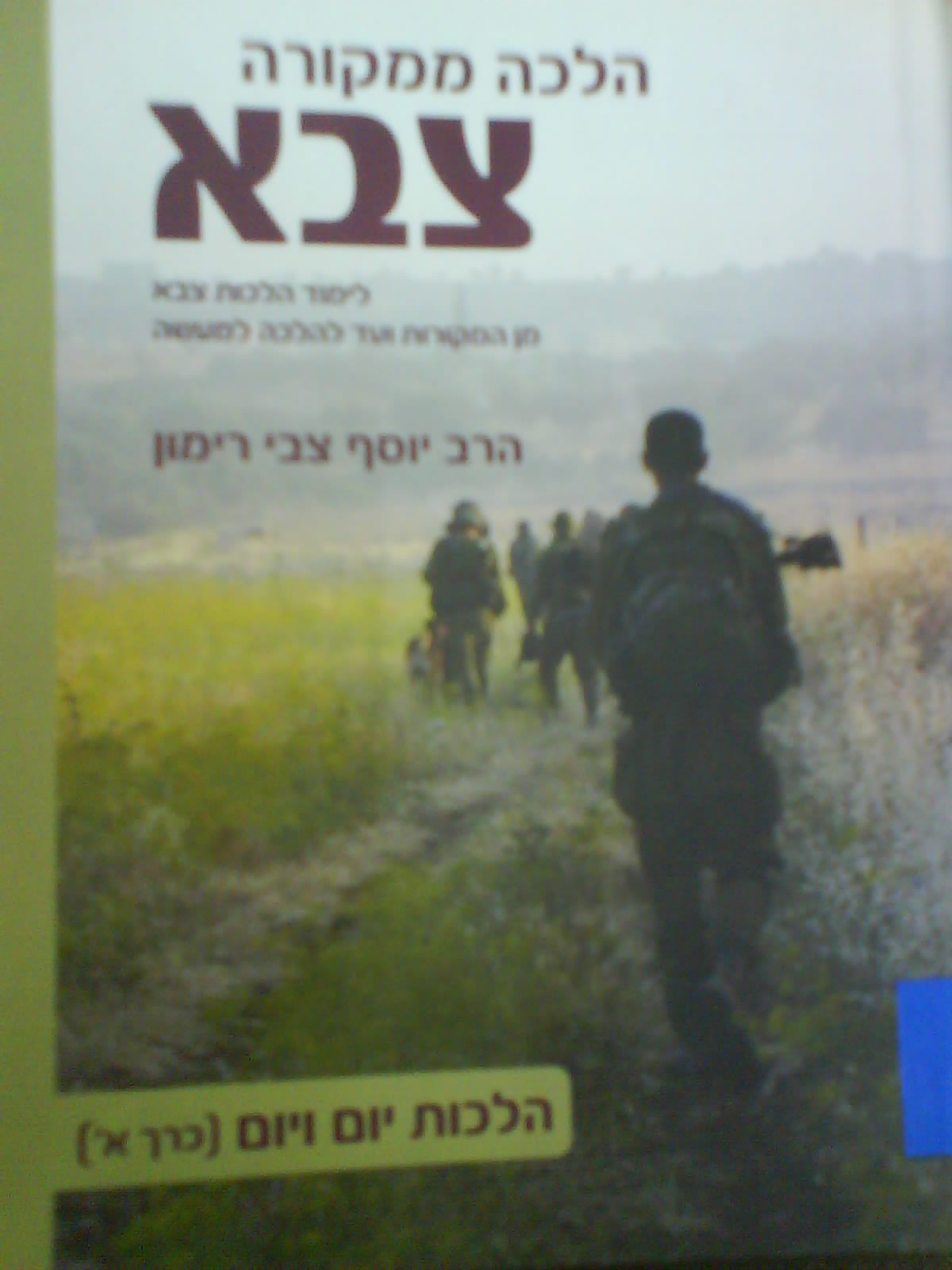
Rabbi Joseph Zvi Rimon: "Halacha for religious Israeli Soldiers"


B"H

Rabbi Joseph Zvi Rimon published a book listing and explaining the Halachot how a religious Jew can lead a frum life as a soldier in Israel's Defense Forces (IDF). The author even explains how a male soldier should behave in case he is getting in contact with female soldiers. 

I don't know whether this bookwill be mainly used by national religious soldiers, as Haredim (e.g. Chabad soldiers) may rather follow their own advising Rabbis and traditional Halachot.


Photos: Miriam Woelke

Wednesday, January 5, 2011

Rabbi Joseph Karo and the 32 Paths of Wisdom


B"H

Last Friday morning, when our "Rambam Nutrition Seminar" went on a tour through the old city of Zfat, Rabbi Mordechai Siev from the Chabad hostel ASCENT also took us to the Synagogue and Beit Midrash of the famous author of the Shulchan Aruch (Code of Jewish Law), Rabbi Joseph Karo (1488 - 1575).


And here we are, in the courtyard where Rabbi Joseph Karo used to live and have his Beit Midrash (see the blue door on the picture below). 

There is a very famous story about the Rabbi:
Once he was teaching and one of his students asked him a very difficult question. As Rabbi Karo didn't know the immediate answer to the question, he promised his student that he would look it up at home. The Rabbi went home, sat over the Talmud and just couldn't find the answer. In the end, he locked himself up until he finally found the answer. As a matter of fact, Rabbi Joseph Karo claimed that an angel had eventually taught him the right answer to the student's questions. 

After a few days and knowing the answer, the Rabbi returned to his Beit Midrash and wanted to tell the student the proper answer. However, somewhere on his way he overheard a conversation where another student, only a beginner at his Beit Midrash, provided the student with the particular answer. The Rabbi got very upset and didn't know what to think. How can it be that he, Rabbi Joseph Karo, has to sit at home and study for a few days in order to find the answer to this difficult question ? On the other hand, a beginner in Judaism just shows up and knows the answer right away.

Rabbi Karo went to one of the Kabbalists in Zfat and asked for a solution. The Kabbalist, however, told him the following:

"There are 32 Paths of Wisdom in this world and every Jew has his own path of wisdom to explore. Each one of us has his or her particular path. So did Rabbi Joseph Karo and so did the beginner student. 
Because everyone of us has his individual path of wisdom, my task may be that I understand something and teach it but this doesn't mean that you must understand and teach it first. Maybe it is my individual goal in life to use my path of wisdom and teach something to another person whereas someone else goes along a different path and has to understand and teach something completely different. 
In this case, it was the beginner student's task to teach the answer and not the Rabbi himself".


Photos: Miriam Woelke

Thursday, December 23, 2010

Rabbi Shlomo Aviner against Talkbacks

B"H

The Chief Rabbi of Beit El, Rabbi Shlomo Aviner, is not a Rabbi who I feel I would particularly listen to but now he just made a very good point. Rabbi Aviner spoke out against reading TALKBACKS on websites. Article reactions can be positive and add a few new information to the article. However, they can also be very negative and thus destroy your content.

What you as a writer always have to consider: You don't know the person who is behind the comment. It can be someone totally honest but, in many cases, those talkbackers are nothing but fakes. For instance, I have noticed that quite a few people who try to make a "Jewish" comment actually turn out as Christian readers. It is those people and plenty of left - wingers getting Jewish religious concepts wrong. Sometimes they don't even try to understand but just look for the negative in order to use it in a negative way. 

So far, the worst Talkbacks I have had on Facebook where I cut out many "friends". False converts to Judaism or call them Messianics, left - wingers and many Americans of all religions who try to tell Israel what to do and how to behave. 

I seriously have to admit that those Christian talkbacks on my content go on my nerves because I don't want to have anything to do with such people. They can read their own sites but not mess around with Jewish content. Or to say it in other words: They don't have a "Neshama E - lo - kit" but still think they know everything better then Jews. It does have a negative influence on me, as I don't want to deal with such KLIPOT !