Showing posts with label Torah Figures. Show all posts

Thursday, November 15, 2012

Armon HaNatziv and Avraham

B"H

The Jerusalem neighbourhood "Armon HaNatziv" (Talpiyot - East) is located rather far away from the city center; you can find it behind the Promenade and Talpiyot / Arnona. The approximately 15,000 inhabitants of Armon HaNatziv consider their neighbourhood as still affordable, as rents are not that high yet.  

According to a legend (it could be also Aggadah or Midrash), it was on top of Armon HaNatziv (maybe where the UN Headquarter is located today) that Avraham spotted out the Tempel Mount (Har HaBayit) when he took his son Yitzchak to sacrifice him. The Temple Mount used to be much higher in ancient times and it was Herod who flattened the mountain in order to build the Second Temple.


View from the Jerusalem Promenade to the old city including the Temple Mount


When you look into the opposite direction you see Armon HaNatziv and the hills of Gush Etzion (Hebron, Kiryat Arba, etc.) in the background. 


Armon HaNatziv


 The white containers on the rooftops serve as hot water storage heated up by solar systems

Photos: Miriam Woelke

Monday, October 29, 2012

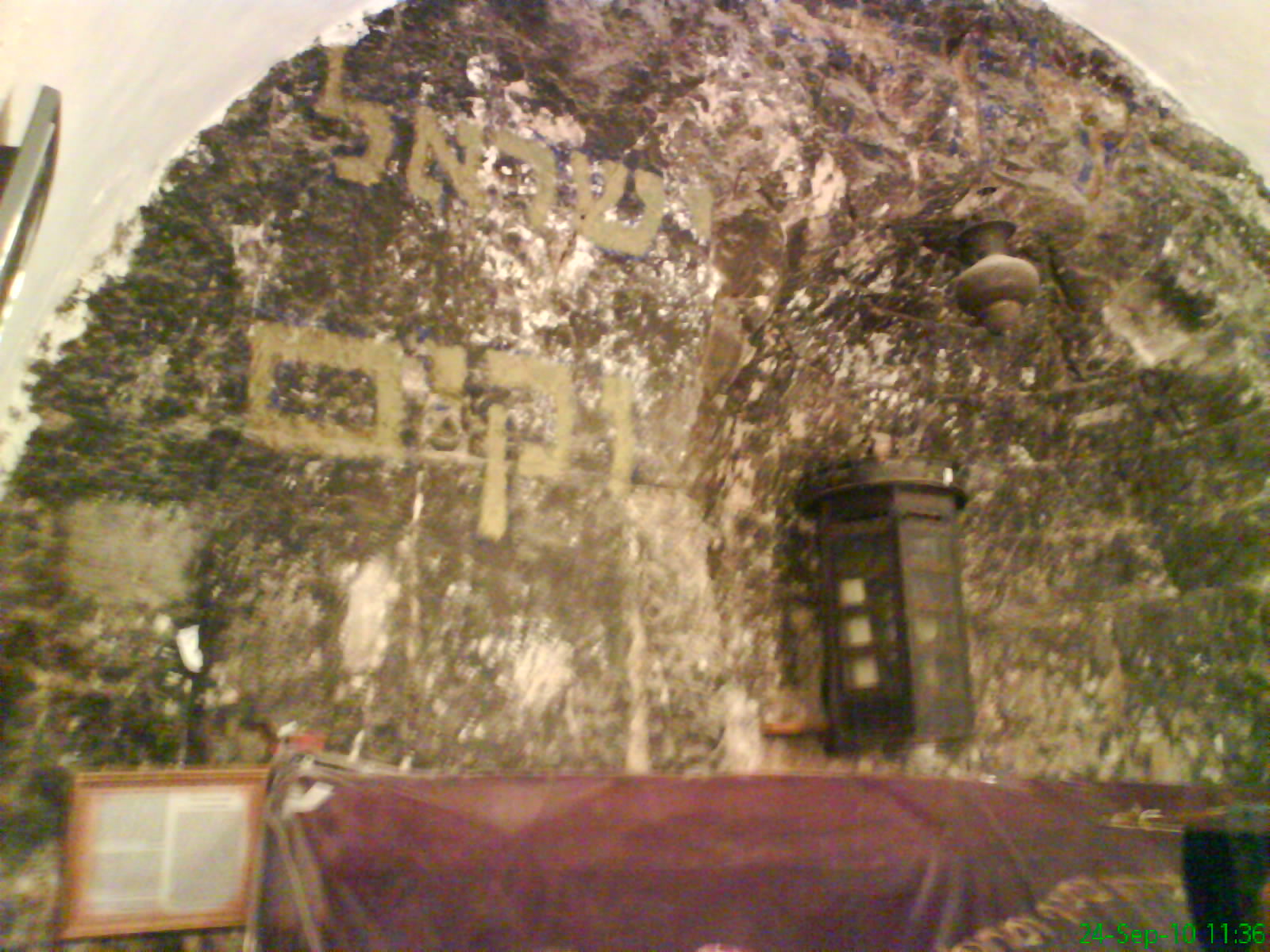
The Cave of Shem and Ever in Zfat

B"H 

I am back in Zfat (Northern Israel) until Wednesday and while I was walking around after my arrival today, I found the door to the famous cave of Shem and Ever open. I was able to take a glimpse inside. The following video came out a bit dark but the photos may provide you a better impression.

Shem used to be the youngest son of Noach (Noah) and Ever was Shem's grandson. Jewish tradition says that the two were studying Torah in this particular cave. 

When we say that our ancestors studied Torah although the Torah wasn't then officially given, well, there are different opinions on that concept. They surely didn't study Torah as we do today but it is explained that the ancestors, in particular Avraham, had the principle in mind. 

However, I do not yet have the historical knowledge of how and why it was stipulated that this cave used to be Shem and Ever's cave. 


Copyright / Photos: Miriam Woelke

Thursday, October 25, 2012

Rachel's Yahrzeit

B"H


This Shabbat, Parashat Lech Lecha, is the Yahrzeit of our foremother Rachel and Kever Rachel offers some great information and a LIVE CAM:


See KEVER RACHEL 

http://www.keverrachel.com/content.asp?lang=en&pageid=35


You can watch a Live Video here:

Thursday, March 1, 2012

Birthday and Yahrzeit of Moshe Rabbeinu

B"H

Tomorrow (Thursday) is the 7th of Adar (Zain Adar) and this date stands for the birthday and the Yahrzeit of Moshe Rabbeinu.

Talmud Megillah 13b teaches us that, first, Haman wished to destroy Mordechai alone but he changed his mind into destroying all the Jews. When Haman was casting the lots, he saw that the lot fell on the month of Adar. He thought that this would be a great sign, as Moshe had died in Adar. The month of Adar would not be an unlucky month for the Jews. However, Haman did not realize that while Moshe died on the seventh of Adar, he was also born on the seventh of Adar. Rashi commentates: Moshe's birth on that day compensated for the day's negative aspect of being the day of his death.

The Torah does not exactly tell us the date when Moshe died but Chazal figured it out be the days / time given when the Jews mourned Moshe (see the Book of Deuteronomy - Sefer Devarim 34:8).

Rabbi Shalom Arush writes in his book "The Garden of Emunah" about our mission in life:

"Each of us comes to this earth for the express purpose of fulfilling a mission. Some people enjoy a long life and others pass away at a young age. Our souls come to this earth for certain Tikkunim (soul rectifications) and others have to fulfill special tasks. The reason why some people live longer and others don't is beyond our understanding".

There is an opinion that, as soon as we fulfill our task in life, we pass away. I am not sure if this is always the case because the Arizal (Rabbi Yitzchak Luria) says in his book "Shaar HaGilgulim - The Gate of Reincarnations) that sometimes people soul's are reincarnated because they didn't fulfill a special task / rectification.

Obviously Moshe's task was fulfilled and he passed away. Nevertheless, it says that Meshiach's soul is going to have a spark of Moshe's.

Saturday, December 17, 2011

Parashat Vayeshev: Joseph’s Pit

B”H 

One of the SHEARIM readers asked from where do we know that the pit where Joseph was thrown in by his brothers was not empty (as the Torah says) but contained snakes and scorpions ? How do Talmud (Shabbat 22) and Torah commentators draw this conclusion ? 

An interesting question and the answer is, once again, showing us that there is much more behind the Torah than just reading the word. The Jewish task should be to dig much deeper into the Torah content and find out what G – d is really trying to tell us. Furthermore, the Torah has a revealed and a hidden side and not everything seeming so obvious can be taken literally. Many things in the Torah are not that clear at all and this is why G – d provided us with the oral law which, later on, was put together in the Talmud. 

Parashat Vayeshev 37:24:

“Then they took him, and cast him into the pit; the pit was empty, no water was in it”. 

Those are the words of the Torah. So, apparently the brothers threw Joseph into an empty pit, as the Torah tells us but why does it also state that “No water was in it ?” Isn’t an empty pit empty ? Why do I have to add that no water was in it when the pit is empty anyway ? 

I want to begin with a famous metaphor on this Torah Passuk: Symbolically speaking, a head which is empty of Torah, is vulnerable to harmful ideologies and thoughts - Implying that in Jewish literature, the Torah is also referred to as water. Man cannot live without water and thus he cannot live without Torah. 

Rashi commentates that the “empty pit” and “no water inside” were mentioned together because this is what the brothers saw. An empty pit, meaning that there was no water inside. But, and this is what the brothers didn’t know and see: The pit contained snakes and scorpions. G - d let a miracle happen and Joseph survived in the pit. Later on, his brothers sold him to the Ishmaelites. 

Had the brothers known that G – d had just created this kind of miracle for Joseph, they would not have sold him. However, G – d’s plan was that Joseph had to go down to Egypt in order to get the entire family down where the Jews had another important Tikkun (soul rectification) to carry out.

Monday, July 4, 2011

Last Night: Thousands of Jews were praying at Kever Yosef in Shechem

B"H

In April 2011, the Breslover Chassid Ben – Yosef Livnat was shot at Kever Yosef (the grave of the biblical Yosef) by Palestinian security forces. Nevertheless, not only since the death of Livnat, a visit at the Kever in the Palestinian terror town of Shechem is not without any controversy.

Despite all security issues and without being afraid of Palestinian mobs and snipers, thousands of Jews came to Shechem last night in order to pray at Yosef's grave. Protected by the Israeli army.


All Photos HERE !

Tuesday, June 28, 2011

Sefer Kushiot: Why Avraham and Yaakov received new names from G - d


Photos: Miriam Woelke

B"H

I love those questions asked and answered in SEFER KUSHIOT. Basically the entire book consists of Q & A. Here is a short example:

Why did Avraham and Yaakov receive new names from G - d whereas Yitzchak's name was never changed (by G - d) ?

Anyone has an answer ?
If not, look into the book.:-)

Wednesday, April 27, 2011

Yahrzeit: יהושוע בין נון - Yehoshua Bin Nun


A phone number for those who live in Beitar Illit, Beit Shemesh, Bnei Brak or Jerusalem and would like to reserve space on a private bus traveling to Kever Yehoshua Bin Nun tomorrow night.

B”H

Tomorrow (Thursday) night is the Yahrzeit of the biblical Yehoshua Bin Nun (he took over leadership after Moshe died and led the Jews into Israel). Thousands of Jews will be traveling to his grave in a village called Timnat (Kefel) Hares. The village is located north of Ariel in the Shomron (Samaria).

Yehoshua Bin Nun belonged to the Tribe of Ephraim and was 42 years old when the Jews left Egypt. Later on, he married the famous prostitute Rachav from Jericho who had given shelter to the spies he had sent out.


Kever Yehoshua near the town of Ariel in Samaria (Shomron).


One month ago on Purim: The reading of "Megillath Esther - Book of Esther" at Kever Yehoshua Bin Nun.


Links:


Deeper Insights: Yehoshua Bin Nun

Friday, February 11, 2011

The Birthday of Moshe Rabbeinu

B"H

Today (Friday) is the 7th of Adar (Zain Adar) and this date stands for the birthday and the Yahrzeit of Moshe Rabbeinu.

Talmud Megillah 13b teaches us that, first, Haman wished to destroy Mordechai alone but he changed his mind into destroying all the Jews. When Haman was casting the lots, he saw that the lot fell on the month of Adar. He thought that this would be a great sign, as Moshe had died in Adar. The month of Adar would not be an unlucky month for the Jews.
However, Haman did not realize that while Moshe died on the seventh of Adar, he was also born on the seventh of Adar. Rashi commentates: Moshe's birth on that day compensated for the day's negative aspect of being the day of his death.

The Torah does not exactly tell us the date when Moshe died but Chazal figured it out be the days / time given when the Jews mourned Moshe (see the Book of Deuteronomy - Sefer Devarim 34:8).

Rabbi Shalom Arush writes in his book "The Garden of Emunah" about our mission in life:

"Each of us comes to this earth for the express purpose of fulfilling a mission. Some people enjoy a long life and others pass away at a young age. Our souls come to this earth for certain Tikkunim (soul rectifications) and others have to fulfill special tasks. The reason why some people live longer and others don't is beyond our understanding".

There is an opinion that, as soon as we fulfill our task in life, we pass away. I am not sure if this is always the case because the Arizal (Rabbi Yitzchak Luria) says in his book "Shaar HaGilgulim - The Gate of Reincarnations) that sometimes people soul's are reincarnated because they didn't fulfill a special task / rectification.

Obviously Moshe's task was fulfilled and he passed away. Nevertheless, it says that Meshiach's soul is going to have a spark of Moshe's.

Sunday, December 5, 2010

Baer Miriam - Miriam's Well


The place of Miriam's Well.


B"H

The closest student of the famous Kabbalist Rabbi Yitzchak Luria (1534 - 1572), Rabbi Chaim Vital, once told the following story::

One day, Rabbi Luria and me were traveling in a boat over the Kinneret (Sea of Galilee). When we got to a certain spot at the southern part of the lake, Rabbi Yitzchak Luria pointed at the water and said that this would be the place where the "Baer Miriam - Miriam's Well" is hidden.

In the desert, Miriam's Well was providing the Israelites with water and when she died, the well disappeared with her. The legend says that Miriam is buried in Tiberias and until today, everyone can visit her grave. Many Jews see this as a proof: Miriam is buried in Tiberias and, thus the well cannot be too far away.

It is said that until today the water from the well has healing powers. But this doesn't mean that you should stick your head into the Kinneret and drink. Otherwise you may be surprised because the town of Tiberias is pumping its sewage into the lake. I was told that the sewage is being cleaned before reaching the lake but you never know.


The Haredi (on the left) is standing at the grave of the great 
Kabbalist Rabbi Yitzchak Luria.
The Kabbalist is buried about 40km north of Tiberias; in Zfat (Safed). 

Photo: MIRIAM WOELKE.

Sunday, October 31, 2010

Yitzchak ben Avraham

B"H

Parashat TOLDOT starts with the words:

"And these are the generations of Yitzchak Ben Avraham (the son of Avraham) - Avraham begot Yitzchak".

Why does the Torah mention the same content twice in the same sentence?
Rashi commentates that G - d wanted to make it very clear that, despite the advanced age of Avraham and Sarah, Avraham was the father of Yitzchak and not Avimelech or anyone else. In fact, there were rumours going around in those days that Avraham could not have been the father of Yitzchak but that Sarah had another man. This is the reason why G - d stated very clearly that Avraham was the father. Furthermore, G - d created Yitzchak very much in the image of his father. Meaning: The totally looked alike and people got mixed up whether they spoke to the father or to the son.

In Parashat Lech Lecha 17:18 ff., G - d lets Avraham know that He is going to continue the (Jewish) generations with Yitzchak. Moreover, G - d is going to continue His covenant with Yitzchak.

In Parashat Vayera 22:2 ff., G - d commands Avraham to take Yitzchak (the Torah refers to Yitzchak here "Avraham's only son") and go to the Land of Moriah (today's Temple Mount). What follows is the "Akedat Yitzchak - Sacrificing Yitzchak". Although Avraham also takes Ishmael with him, he later on tells him to wait and goes away with Yitzchak in order to sacrifice him.

In Parashat Chaye Sarah 25:21 ff., we become aware of the main difference between Ishmael and Yitzchak. In Chaye Sarah, the Torah calls Ishmael the son of Avraham to whom the Egyptian Hagar, Sarah's servant, gave birth.

Parashat Toldot, however, starts with the list of the generations of Yitzchak. Yitzchak the son of Avraham; Avraham begot Yitzchak. Whereas Parashat Chaye Sarah refers to Ishmael more as the son of Hagar, the servant. The RASHBAM states in his commentary that there is a main difference here: Ishmael is the son of the servant and Yitzchak is referred to as the "real" son of Avraham. The Rashbam and the Kli Yakar commentate that the verse in Toldot mentions only Avraham who begot Yitzchak. Furthermore, the Kli Yakar states that the Torah refers to Ishmael as the son of Hagar because he took over her bad behaviour as well as the Egyptian culture. Yitzchak only followed the traditions of Avraham and waited until he found a righteous wife and did not take any Canaanite woman as a wife. Ishmael, however, married an idol -worship woman.

The commentators see the main difference in the two statements of the Torah about Yitzchak and Ishmael and the entire content shows us that Yitzchak was chosen by G - d and not Ishmael (as the Arabs claim).

Wednesday, October 27, 2010

The sons of Avraham and Keturah

B"H

This week's Torah Parasha "Chaye Sarah" (25:1 ff.) informs us that Avraham married a second time after the death of his wife Sarah. He married a woman named "Keturah" and most Torah commentators agree that Keturah this is nobody else but "Hagar" (Ishmael's mother and concubine of Avraham).

Rabbi Samson Raphael Hirsch states in his commentary that there was nothing unusual about Avraham marrying a for a second time because he lived 35 years longer than Sarah. After he married Keturah she bore him a few more sons called Simran, Jakschan, Medan, Midian and Shuach. G - d wanted Yitzchak as another forefather of the Jewish people. Also because Sarah was Jewish. A Gentile mother Hagar with her sons would have been able to fulfill that task.
After Avraham and Keturah had raised their children, Avraham saw that he didn't succeed in raising them spiritually. Only Yitzchak had the same thoughts as him but all the other children had different souls. In order to avoid fights about the heritage between Yitzchak and the other sons, Avraham sent his and Keturah's sons to the east.

This is the reason why we sometimes find "Jewish" ideas or behaviour in the Far East. Although the sons from Keturah were not Jewish, they had still taken over certain kinds of attitude from Avraham. Some people of the Far East may have a slightly Jewish behaviour, as their ancestors may have been Jews who got dispersed before and after the destruction of the First Temple.

Today, hundreds of maybe thousands of Indians call themselves "Bnei Menashe - Sons of Menashe" (one of Yaakov's sons). Nobody is able to say whether this is really true. Fact is, that not every Gentile can come and make a claim to be Jewish in order to get Aliyah rights for Israel. Many of those Indians were allowed to immigrate to Israel but had to undergo conversion. Their true intention as well as the extremely fast conversion is questionable and when you ask me, those Indians are not Jewish. Israelis usually don't let them integrate into their society and consider the "Bnei Menashe" as Asian slaves and fake converts in order to seach for a better lifestyle. 
On the other hand, the Indian "Bnei Menashe" do anything but integrate. Simply because they are not interested in Israeli society but rather into Israeli social benefit. They keep on claiming to be "Bnei Menashe" although only the Meshiach can stipulate which Jew is from what tribe. Moreoever, the Indians in Israel demand their rights and ask for the same life just like in India. Only with a bit more cash.

If we could, we would send those false converts back just as Avraham did with his and Keturah's sons.

Wednesday, October 20, 2010

Yahrzeit of Rachel Immenu and Rabbi Meir Kahane


Photo: Kahane Blog

I am not this "Kahane Chai" type. Protesting around and holding speeches with all kinds of fanatic content. I do believe that there are some good Arabs and not everyone is a terrorist.

Although I am not too much into Rabbi Meir Kahane and his movement, I do have to admit that most of the statements he made actually became true. Just look at our looser prime ministers, our mein looser Ehud Barak and the Muslim Barak Hussein Obama including his slave Shrillary.

I wish there was a Meir Kahane today and maybe our country would finally wake up and not deal with a prime minister who is making decisions according his polls (Netanyahu). Instead we are commemorating the 20th Yahrzeit of Rabbi Meir Kahane next week.

Further link to Rabbi Kanahe's teachings:


Huge Yahrzeit event at the Jerusalem Renaissance Hotel next week.

Photo: Miriam Woelke


The second important Yahrzeit already took place yesterday when thousands of Jews gathered at the grave of our foremother Rachel. The grave is located outside Bethlehem (Beit Lechem) and rather looks like a military base. To my shame I must admit that I have never been to Kever Rachel although there is a local Egged bus from Jerusalem to the grave. I think it is bus number 163.


Further information provided by ARUTZ 7

The Grave of King David in Jerusalem

B"H


There is definitely no lack of ancient graves in Israel. Some parts of the country are almost flooded with graves of Zaddikim (righteous / famous Rabbis). However, there are also many doubts about whose grave it really is. Is the location of Rabbi Akivah's grave really his grave ? A local from Tiberias told me the story that many many years ago, a woman lost her way in the dark and ended up falling into a pit. Suddenly she heard voices and the one voice spoke to her. The voice of Rabbi Akivah who said that he is buried at this particular spot. The woman escaped from the pit and, on her way back to Tiberias, marked her way with stones. Since then, people believe that the spot is the grave of Rabbi Akivah.

Furthermore, the location of the graveside of King David on Jerusalem's Mount Zion is more than controversial. Especially because it was mainly the Catholic Church claiming that the spot was the grave of David HaMelech. Others ask, whether King David is not rather buried close to his son Avshalom in the Kidron Valley (near Mount Zion).


Memorial Candles 


The Ezrat Nashim (women's side)


The grave of King David ? 
Covered by a red silk cloth.

Photos: Miriam Woelke