Showing posts with label Temple. Show all posts

Thursday, July 26, 2012

Jerusalem during the Second Temple Period

B"H

The Israel Museum in Jerusalem and its permanent exhibition of the city of Jerusalem during the times of the Second Temple.


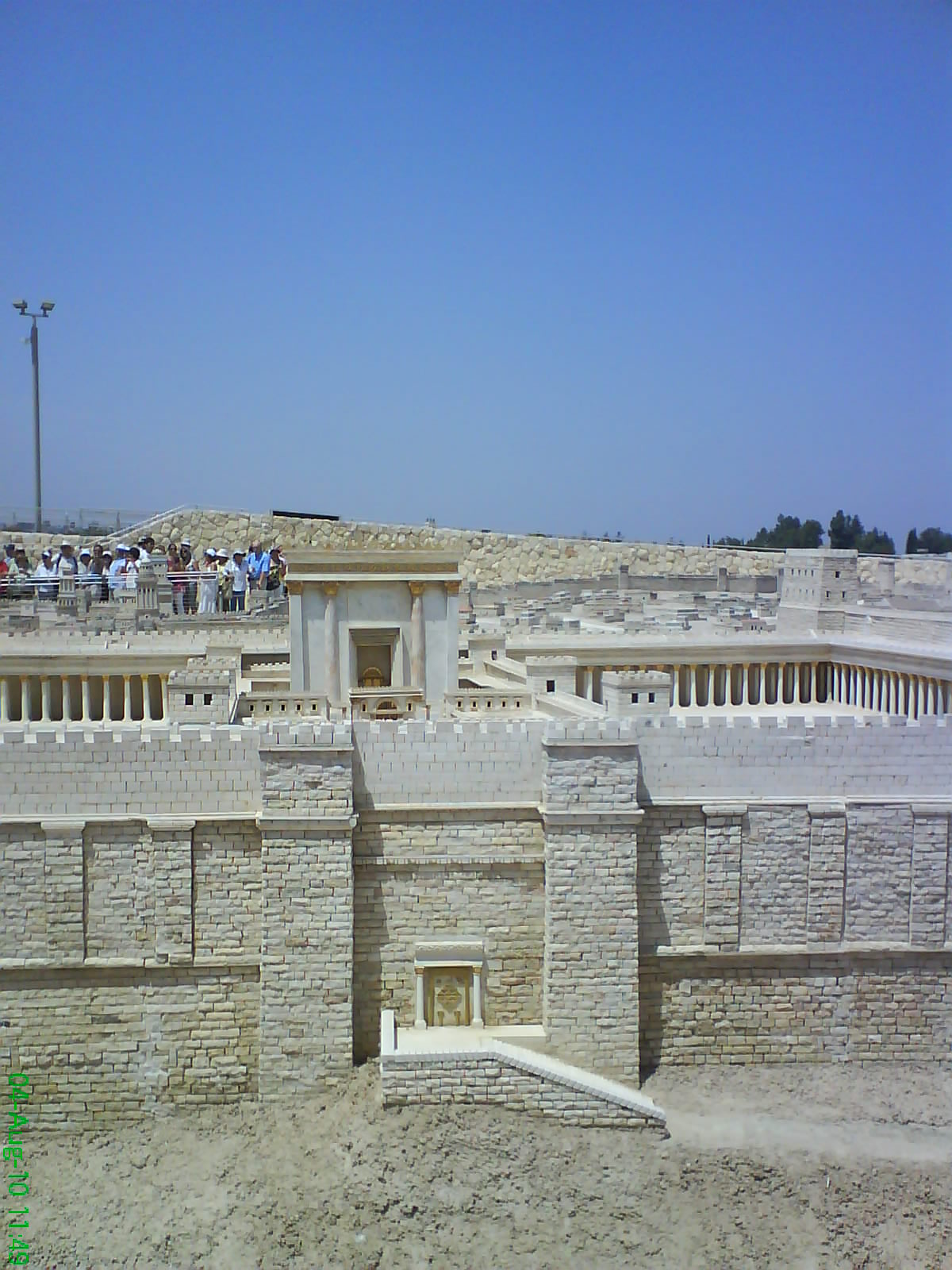


Photos: Miriam Woelke

Sunday, April 22, 2012

The Jaspar Stone and Dama Ben Netina

B"H

In Judaism, sleep is considered as something very important. Not only because sleep is good for your health but also in regard to "not waking up a person in vain". One should respect a person sleeping and not constantly waking him up for no reason. 

The Talmud Yerushalmi (Peah 1:1) teaches us how to honour one's father by telling us about the Gentile DAMA BEN NETINA. The story which is also mentioned in Talmud Bavli - Kiddushin 31a, further teaches us how important sleep can be. 

The person who honoured his father most was actually vicious Esav. Despite all his evil deeds, Esav never forgot to honour his father Yaakov. For instance, he always put on clean clothes before standing in front of his father. 

In the days of the First Temple, a man called Dama Ben Netina used to live in Ashkelon. He was not Jewish and his family was supporting itself with two different businesses: 1. Dealing with diamonds 2. raising cattle and flocks of sheep. 

In the times of the First Temple, the High Priest (Cohen HaGadol) still wore the breastplate Urim ve’Turim. It disappeared after the Temple destruction by the Babylonians. I will digg deeper into the entire topic of the Urim veTurim in a different article. Here I am only mentioning briefly that the Cohen HaGadol used also used the breastplate for getting answers regarding complicated questions and issues. 


The breastplate consisted of twelve precious stones representing the twelve Jewish tribes. The Talmud tells us that once, the Jaspar stone representing the tribe of Benjamin got lost. Thus, a new Jaspar had to be found but this turned out to be very hard. No one seemed to own such a stone. After a while the Jews found out that the Gentile Dama Ben Netina owned a Jaspar.

Money was collected and a Jewish delegation travelled to Ashkelon in order to purchase the Jaspar from Dama. The latter received the Jews in his house but told them to be quiet, as his father was asleep. The Jews told him what had happened and Dama was willing to sell his Jaspar. However, the stone was laying in a safe and the key for the safe was under his father's pillow. Dama Ben Netina refused to wake up his father in order to get the key. 

The Jews kept on offering more and more money but Dama still refused. He said that it is not the money but a matter of honouring his father. The Jews were impressed and returned to Jerusalem. Some time later, a businessman was found who sold them his Jaspar. 

One or two years later, the Jews needed another "Parah Adumah - Red Hefer" for burning it in a special procedure on the Mount of Olives (see Talmud Tractate Parah). Such a cow must only have red hair and not hair of a different colour. It turned out that Dama Ben Netina had such a cow whose ashes are able to bring about spiritual cleansing. 

Again, the Jews went to see Dama and purchased the red cow. This time, the deal took place and Dama Ben Netina only asked for the amount the Jews had offered him before for the Jaspar.

What this story also teaches us is that sometimes we feel like loosing a business. At first we are not willing to agree due to moral reasons but, in the end, another deal may come up rewarding us for the loss. 

Thursday, March 29, 2012

Parashat ZAV - פרשת צו

B"H

This week's Parasha, Parashat ZAV, is all about Korbanot (Sacrifices) in the Temple. The word KORBANOT comes from the Hebrew verb LEHITKAREV - Getting closer to something / someone. While Jews are bringing sacrifices (during Temple times, Gentiles did so on Succot) they are getting closer to G - d. Not necessarily by the sacrifice itself but by their deep and honest repentance. However, Korbanot were not always brought after someone had done something wrong. There used to be sacrifices in order to thank G - d or special Korbanot for the holidays.

When you do something wrong, your Jewish soul (Neshama) will be influenced by your wrongdoing. Our task in this world is to elevate ourselves and souls and not to give in and blemish the Neshama. Of course, we may correct our wrongdoings by repentance but what makes everything a bit more complicated is that even thoughts can blemish your soul. You think something and don't even have to carry it out but it still leaves an influence in your mind and soul.

Today we are much more vulnerable to all kinds of thoughts and it is not only Facebook, Twitter or the entire Internet world causing us confrontations with all kinds of worldy things. Of course, it always depends on how you use the Internet  but still, temptations are around everywhere you look. 


On the other hand, we cannot just lock ourselves away but have to interact with the world. There are times when I would love to lock myself into closed chassidic communities such as Toldot Aharon. Just live in my own backyard and not interfering with the outside world. Just live my own life without being confronted with news about Iran, economy, bombs, unemployment, etc. To be realistic, I wouldn't manage that kind of life for too long and just explode after a while. But for a certain period of time, every human needs a break and has to go inside of himself and think. Do Cheshbon Nefesh, meditate or simply taking some time for himself without media and other people around. 

I think it was the Maharal saying in his commentary on "Pirkei Avot" that a Jew has to interact with the world, as he is not alone on this planet. Worldly affairs are not always negative but what we have to do is learning how to approach them in a positive sense.

Friday, February 24, 2012

Primitive Thoughts on PARASHAT TERUMAH

B"H

"Primitive Thoughts on Parashat Terumah ?"
Lets call it "Practical Thoughts !"
Or maybe YES "primitive" ?

G - d is giving all the instructions for the building the Mishkan (Tabernacle). Later on, certain families are appointed for the duty of carrying poles, walls, all kinds of parts while the Israelites travel through the desert. Those male family members of Moshe and Aharon seem to look at each other in a way of jealousy. At least some members.
Why is he allowed to carry this and I am only carrying that ?
It just looks like a typical male competition behaviour.

Who can imagine today what it meant to have a Mishkan ? We barely imagine having a Temple but who speaks or thinks about the original Mishkan except when it comes to some Torah readings throughout the year ? Okay, there was this Mishkan consisting of many parts but then the First Temple came into existence. The Mishkan was gone and some sources say that most of it was destroyed or burnt down.

Why is G - d giving every little single detail about how to build the Mishkan. Our Sages say in order to make us used to go into detail. The Mishkan was to be built in detail and so we have to keep the Mitzvot. Not going away from the law and making it easier but strictly follow the written and oral law.

Rabbeinu Bachya has several spiritual commentaries on Sefer Shemot (the Book of Exodus). The Mishkan was the exact counterpart of the Temple (Beit HaMikdash) in the upper spiritual worlds. As we know, everything in this material world has a counterpart in the upper spiritual world. Even human beings.

So, what does that mean ?
That there is another Miriam walking around in the upper worlds ? That there is another Tempel standing up there ? Another Jerusalem but just somewhere above us ?
What do those people there think when they look down on us ? What do we think ?

Basically it means that the Mishkan was perfect. The way it should be because G - d's Shechinah (Presence) was residing in there. So is the upper Miriam. She doesn't walk around and hopefully I won't meet my perfect "I". The other Miriam is the perfect person I should be.
The upper Jerusalem is the perfect Jerusalem; how it should be.

The concept with the counterparts is not to be taken literally but to be understood on a spiritual level. We can turn the Jerusalem in this world into a perfect Jerusalem. By doing Mitzvot, for instance. By changing the city and us into existences completely following G - d's will. And, in this respect, the Mishkan (Tabernacle) was perfect.

Today, each of us has to work on that in order to get a taste of the upper worlds.

Sunday, January 1, 2012

Jewish man attacked by Israel's leftists

B”H 

I know Yaakov Pauchi for about ten years and I also know that he lives in the small Jerusalem neighbourhood called “Shimon HaZaddik”. Right between the Jewish neighbourhood of Ma’a lot Dafna and East Jerusalem. Between Mea Shearim and Ramat Eshkol. 

Who was Rabbi Shimon HaZaddik (Rabbi Shimon the Righteous), whose grave is located in the neighbourhood named after him ? 

Rabbi Shimon was one of the first High Priests (Cohen HaGadol) of the first era of the Second Temple. Not the beautiful building we know. That one was built much later by Herod. After the First Temple was destroyed by the Babylonians and thousands of Jews were taken in exile, many finally returned under Ezra (the Prophet). When they returned to Jerusalem, they began rebuilding the Temple. Actually the Talmud lists us one opinion that only the roof of the First Temple got destroyed by the Babylonians. Others say that the entire building was destroyed. 

Rabbi Shimon HaZaddik himself is mentioned in theTalmud . I read that he was one of the last, or even THE last, righteous Cohen HaGadol because shortly after he died, corruption began. Anyone with money could become the new High Priest and didn't even have to be a Cohen anymore. Jerusalem's upper class became greedy and didn't care about G - d and Torah. The only thing bothering was that every Yom Kippur, the newly appointed Cohen HaGadol died because he had to enter the Kodesh HaKedoshim (the Holy of Holies). And, as we know, only real and righteous Cohanim (Priests) are able to do so. Other will die and not come out alive. 

Israel's radical left has been demonstrating together with the Palestinians in front of the grave as well as the neighbourhood. They don't care about Jewish history and the leftists claim that the area belongs to East Jerusalem. 

Yesterday another demonstration took place and Yaakov Pauchi got injured by one of the left - wingers. I was shocked seeing his picture in the news this morning.

Wednesday, August 17, 2011

The Jerusalem of the Second Temple Period

B"H

One of my readers sent me a nice link showing photos of the Second Temple model at Jerusalem's Israel Museum. Actually I was visiting the exhibition a year ago and took photos published here:

Virtual Reconstruction: The SECOND TEMPLE of Herod


Tuesday, August 9, 2011

Further Tunnels from the Second Temple period discovered

B”H

How Jewish fighters against the Romans fought the enemy and escaped: Archeologists discovered further tunnels underneath the Old City of Jerusalem. 


All Pictures HERE !

Friday, July 22, 2011

Did the bell belong to the Cohen HaGadol ?

B"H

Archeologists found a rare bell in the City of King David near the Temple Mount. May the bell have been part of the High Priest's (Cohen HaGadol) official Temple clothing ?


But even if, in the Messianic Era, the Third Temple will be built and Levi'im as well as Cohanim are going to continue their Temple tasks. Just like in the past two Temples.

Monday, March 7, 2011

Tunnel Tour below the Kotel (Western Wall)

B"H

Today's Western Wall (Kotel) is not the original place where the Jews at Temple times used to pray. The Kotel is one of the outer walls of the Second Temple but the Holy of Holies (Kodesh HaKedoshim) stood where now the Dome of the Rock is located.

The plaza in front of the Kotel is brandnew and when you want to walk on ancient stones, you either need to enter the OPHEL nearby or participate in the tunnel tours approx. 30m below the Kotel. 

The video shows the original shopping street outside the Second Temple which now is located underneath the Kotel Plaza.

Monday, August 30, 2010

The Ramban on Molech

B"H

The Ramban (Nachmanides, 1194 - 1270) wrote a detailed commentary on the idol - worship of Molech which took place during the First Temple period. The Gemara (rabbinic discussions) in the Talmud Tractate Yoma 9b lists three reasons for why the First Temple in Jerusalem was destroyed. Why let G - d the Temple being destroyed although it was King Salomon (Shlomo HaMelech) who built it ? Why had a destruction to take place ?


Another question: Why should a destruction not take place ? Didn't the Prophet Yechezkel not prophecies a Third Temple in the time of Meshiach ? A Third Temple where the Cohanim and Levi'im serve and Korbanot (sacrifcises) are being brought. Thus the two Temples had to be destroyed in order to pave the way for Meshiach and the Third Temple.

Sexual perversion, murder and idol - worship were reason enough for G - d to destroy the First Temple. The Babylonians were just a tool of G - d's infinite and perfect will.
One of the most famous form of idol - worship during the times of the First Tempel was the worship of "Molech". Executed by special Molech "priests" and taking place in the so - called "Tofet" near today's Cinematheque and Sultan's Pool (Jerusalem). Just right across Jaffa Gate.

The Ramban wrote a special commentary about Molech in Parashat Acharei Mot (Book of Leviticus / Vayikra):

Molech was an idol and Rabbi Avraham ibn Ezra wrote that it is possible that Molech is identical with MILCOM of the Ammonites.

Rashi explained the Molech idol - worship procedure:

The father would hand over his son to the priests, and the priests lit two pyres  (one opposite the other), and they made the child pass on foot between the two fires. 
Rashi asked the question whether a father acting this way is really guilty of worshipping an idol because the son is not touching the fire but only walking through the two pyres. The Torah doesn't allow the Jews to pass the children to Molech: "Le Ha'avir LaMolech". "Le Ha'avir" here stands for actually passing through the fire but the son didn't do so. Moreover, the father didn't deliver his son to Molech but to the priests who then gave it to Molech.

The Ramban, however, has a totally different opinion: He says that the son had to walk into the pyres and was burnt until he died. Furthermore, the Ramban claims that the Gods of the Sepharvaim (see Kings II, 17:31) are also identified with Molech, for their surnames Adrammelech and Anammelech denote kingship (from the Hebrew word "Melech - King").

"Molech" and "Baal" were the most popular forms of idolatry during the ear of the First Temple and both were, at certain times, identical. The Talmud Tractate Sanhedrin tells us a very famous story about how Chizkiyahu's (Hezkiah's) mother rubbed him with the oil of a salamander. His father Ahaz made him pass the Molech but Chizkiyahu survived due to his protective mother.

Not only Ahaz used to sacrifice his children but also King Menashe.


Further Link on the Subject:

Thursday, August 5, 2010

ISRAEL MUSEUM Exhibition: The Jerusalem of the Second Temple Period

B"H

I went to the ISRAEL MUSEUM (Jerusalem) yesterday and took some pictures of the firm exhibition of the "Jerusalem during the Second Tempel".


Photos: Miriam Woelke

Sunday, July 18, 2010

The First Temple and the Lost Ark


Imitation of the Ark


B"H

With 17 Tammuz (about three weeks ago), we have entered the three – weeks mourning period before 9 Av (Tisha be'Av). On Tisha be'Av (this Monday night and Tuesday) we commemorate the destructions of the First and the Second Jerusalem Temple. Today we are praying for the arrival of Meshiach, the building of the Third Temple and the reinstitution of the Cohanim and Levi'im service in the Temple.

The Babylonian empire was founded in 441 BCE (according to the Jewish calendar in 3319). Nebuchadnezzar took the throne after he threw out the Assyrians. Only one year later, Nebuchadnezzar's army reached Judea and arrested King Yehoyakim. Seven years later, in 433 BCE (according to the Jewish calendar in 3327), the Babylonians destroyed the First Temple in Jerusalem and was dragging thousands of Jews as well as King Zidkiyahu into the Babylonian Exile.

For the following 52 years, the Land of Israel was almost abandoned. Not entirely because there were Jews living in Israel at all times but most of the population was gone. Jeremia's (Yirmeyahu's) Prophecy: "And G – d spoke: After seventy years in Babylon, I will remember you and return you to this place". This happened with Ezra the Prophet: The Persian King Darius (a son of the Jewish queen Esther) allowed the Jews the return to Eretz Israel.

Talmud Yoma 54 discusses different possibilities where the Ark (Aron HaKodesh) could have vanished. Since then, researchers, historians and adventurer have been busy finding the Ark. Just take a look at Indiana Jones.:-)
So far, nobody has ever found the lost Ark of the Jews. Some claims state that the Ark was taken to Babylon, others claim that the Ark is in Ethiopia but the most likely solution is that the Ark has never left the Temple Mount. The Talmud teaches that before the Babylonians got hold of the First Temple, the Ark was hidden in secret tunnels underneath the Temple Mount. In fact there is a secret tunnel system under the Temple Mount leading into different parts of Jerusalem.

The Gemara (rabbinic discussions) in Yoma even tells us the exact location where the Ark may be hidden. To undermine the claim the Gemara tells us about a certain event happening during the times of the Second Temple:
Once a Cohen (Temple Priest) was busying himself inside the Temple and noticed an uneven pattern in the floor. Just as if someone had removed parts of the floor and later returned. The Cohen ran to his friends and wanted to tell them what he had seen but at this moment he died. The Talmud Yerushalmi Shekalim 6:1 – 2 teaches about this rather strange incident. The Tiferet Israel commentates that G – d didn't want the Cohen to reveal the location of the hidden Ark and this is why the Cohen had to die.

There are many many legends and stories about the Ark but it will only be rediscovered when the time of Meshiach has come. The Ark together with the Ten Commandments, the ashes of the Red Cow (Parah Adumah) or Aharon's stick.
The question "Why the Palestinians haven't found the Ark" arises. Aren't they digging like mad on the Temple Mount just in order to get rid of any Jewish signs ? Answer: Sometimes you are standing right in front of an object but when G – d doesn't want you to see it, you won't even notice it.

Reish Lakish says in the Gemara in Yoma 54a:
When the Gentiles (here: Babylonians) entered the Sanctuary, they saw the Cherubim joined together".

The Talmud Tractate Bava Batra 99a teaches that the Cherubim (the two angels on the Ark) were facing each other when Israel (the Jews) acted according to G – d's will. As soon as the Jews did the opposite and sinned, the two Cherubim were looking into opposite directions. Why then were the two Cherubim embracing each other when the Babylonians destroyed the First Temple ? Answer: Because G – d wanted the nations to see how much He loves Israel (the Jews).

Monday, June 28, 2010

17 Tammuz - Shiva Asar be'Tammuz


Model at the Israel Museum in Jerusalem: 
Jerusalem at the time of the Second Temple.


B"H

Tomorrow, Tuesday 29 June, we are fasting from early in the morning until the evening after it has become dark. The 17 Tammuz has been a sad day throughout Jewish history.
The most famous event on that day was when Moshe came down from Mount Sinai and saw the Jews dancing around the Golden Calf (Egel HaZahav). He smashed the tablets (Luchot), as well all know. Many years later, our enemies (e.g. the Babylonians or the Romans) were slowly slowly conquering Jerusalem and the First and the Second Temple. With 17 Tammuz, a three - week - long mourning period starts ending with Tisha be'Av (9th Av). On Tisha be'Av, both Temples were destroyed: In 586 BCE the First and in 70 after the begin of the common era, the Second Temple.

Other tragic events happened to the Jews:
On 17 Tammuz 1944, the Nazis destroyed the ghetto in Kovno and sent all the Jews to the death camps.

Fast days have the task to bring the Jews to do Teshuva (return to G - d). We should then study Parashat Ki Tisa (the event with the Golden Calf). We don't just read or study Torah but what we have to do is to internalize the content and Mitzvot. The laws are G - d's will (Ratzon HaEliyon) and by keeping them, we should try reaching a special closeness (Devekut) to Him. The chassidic book "Bnei Yissachar" commentates after the arrival of Meshiach, 17 Tammuz as well as 9 Av are going to turn into joyous days where we will have feasts.

Halachot for 17 Tammuz:

a) No eating

b) No drinking

c) No joyous events

Halachot until Tisha be'Av:

a) No Jewish weddings are taking place.

b) No parties or listening to music.

Why are we introducing the mourning period already three weeks before Tisha be'Av ?
Because the Jews in the days of both Temple destructions, were fighting and many lost their lives. Our enemies didn't let any food into Jerusalem and thousands of people died of hunger.

Let us hope that Meshiach will be coming soon and build the Third Temple.

Zom Kal – Have an easy Fast !


Absorbing the Sanctity of Eretz Israel
Source: "Celebration of the Soul" by
Rabbi Avraham Yitzchak Kook

The more difficult it is to endure the air of the Diaspora, the more one feels the impure spirit of the impure land. This is a sign of the inner absorption of the sanctity of Eretz Israel, of the heavenly mercy that will not abandon one who is worthy of dwelling in the pure shadow of the land of life, even when he is far away and wandering in his exile. The foreignness felt in the Diaspora ties all of one's inner desire to Eretz Israel and its sanctity of the Land bores deeper and deeper.
When the depth of the holy yearning of love for Zion, the memory of the Land and all its preciousness, wells up in the soul of the individual, it flows like a spring for the entire collective, for all of the thousands of sould bond to Him. The sound of the Shofar heralds the ingathering of the dispersed and great mercy abounds. Israel's hope for life glitters, the blossom of G - d flourishes, and the light of salvation and redemption ramifies and spreads like the dawn spreading over the mountains.

Monday, May 31, 2010

Longing for Beit HaMikdash (the Temple)

B"H

When you walk through Jerusalem's Jewish Quarter in the Old City today, you will mostly find antique sites from the Second Temple period. Here and there are some remains of the city wall from the period of the First Temple, however, everything else concentrates on the Second Temple. The Kotel HaMa'aravi - West(ern) Wall or the nearby Ophel. You can join tours taking you 30 meters below where the original market street in front of the Temple used to be. Where we stand today is about 30 meters on top of the original site where Rabbi Akivah or Rabbi Gamliel used to walk.

It is very emotional walking through the tunnel system underneath the Kotel as well as seeing the stones (from the top of the wall) thrown down by the Romans during the Second Temple destruction. On some of those stones you can still see black spots from the fire when the Temple was burning.

In the Ophel, right next to the Kotel Plaza, you can walk along the ancient shopping mall in front of the Second Temple. Where the Jews used to buy their sacrifices for the Temple. You can sit there and imagine how it used to be in those days. Busy streets, Jews buying sacrifices and walking up to the Temple. Going to the Mikweh (ritual bath) and then handing in the animal to be sacrificed.

What a great feeling must this have been and how could the people 2000 years be so ignorant of all the Shechinah (G - d's presence) surrounding the Temple. At least in those early days of the Second Temple when corruption among the Cohanim did not yet take place.
How could the Jews start fighting when they had a Temple ? When the Prophet Jeremiah (Yirmeyahu) was warning them.

The question is if we today would be so much better. We may think so but when it comes to fights, arguments and priorities we are probably not so much better than our ancient ancestors. Is it of any use sitting in the Ophel and dreaming about the good old days with the 
Second Temple ? Of course all those ancient sites and stones provide the visitor with a certain emotional feeling but how about concentrating on the future ? As we know from the Talmud, the Second Temple didn't include such a high level of the Shechinah as the First Temple did. There was no more Aron HaKodesh (ark with the tablets), all the great prophets were gone, the Shamir (a kind of small animal King Salomon used for cutting the stones of the First Temple) had vanished and all the other visible miracles were gone.
The Talmud Tractate Yoma explains us that only a bit more than 40,000 Jews came back to Israel from the Babylonian Diaspora. Hundreds of thousands of other Jews preferred staying in Babylon where they had built up their businesses. Why returning to Jerusalem where there are only ruins ? The result was that the Second Temple has never reached the level of Kedusha (holiness) as the First Temple did.

Instead of dreaming about a glorious past we should concentrate on the future; meaning on Meshiach and the Third Temple. Not looking back in history but imagining us sitting in the Third Temple and we should all do something that we get there very soon.

Thursday, February 18, 2010

Primitive Thoughts on Parashat Terumah

B"H

"Primitive Thoughts on Parashat Terumah ?"
Lets call it "Practical Thoughts !"
Or maybe YES "primitive" ?

G - d is giving all the instructions for the building the Mishkan (Tabernacle). Later on, certain families are appointed for the duty of carrying poles, walls, all kinds of parts while the Israelites travel through the desert. Those male family members of Moshe and Aharon seem to look at each other in a way of jealousy. At least some members.
Why is he allowed to carry this and I am only carrying that ?
It just looks like a typical male competition behaviour.

Who can imagine today what it meant to have a Mishkan ? We barely imagine having a Temple but who speaks or thinks about the original Mishkan except when it comes to some Torah readings throughout the year ? Okay, there was this Mishkan consisting of many parts but then the First Temple came into existence. The Mishkan was gone and some sources say that most of it was destroyed or burnt down.

Why is G - d giving every little single detail about how to build the Mishkan. Our Sages say in order to make us used to go into detail. The Mishkan was to be built in detail and so we have to keep the Mitzvot. Not going away from the law and making it easier but strictly follow the written and oral law.

Rabbeinu Bachya has several spiritual commentaries on Sefer Shemot (the Book of Exodus). The Mishkan was the exact counterpart of the Temple (Beit HaMikdash) in the upper spiritual worlds. As we know, everything in this material world has a counterpart in the upper spiritual world. Even human beings.

So, what does that mean ?
That there is another Miriam walking around in the upper worlds ? That there is another Tempel standing up there ? Another Jerusalem but just somewhere above us ?
What do those people there think when they look down on us ? What do we think ?

Basically it means that the Mishkan was perfect. The way it should be because G - d's Shechinah (Presence) was residing in there. So is the upper Miriam. She doesn't walk around and hopefully I won't meet my perfect "I". The other Miriam is the perfect person I should be.
The upper Jerusalem is the perfect Jerusalem; how it should be.

The concept with the counterparts is not to be taken literally but to be understood on a spiritual level. We can turn the Jerusalem in this world into a perfect Jerusalem. By doing Mitzvot, for instance. By changing the city and us into existences completely following G - d's will. And, in this respect, the Mishkan (Tabernacle) was perfect.

Today, each of us has to work on that in order to get a taste of the upper worlds.

Thursday, July 30, 2009

Tisha Be'Av 5769 in Jerusalem

Tisha Be'Av impressions from the Kotel (Western Wall)


Emotional mourning about the lost Temples


All pictures can be viewed here:

http://bhol.co.il/news_read.asp?id=11147&cat_id=2

Tuesday, July 28, 2009

Tisha Be'Av in Jerusalem

B"H

Tomorrow night (Wednesday), the Jewish fast day "Tisha Be'Av" is starting. Until Thursday night we are mourning the destruction of the two Temples in Jerusalem. It says that with the arrival of Meshiach and the building of the Third Temple, this day is going to turn into a day of joy.

The right - wing "Women in Green" including the activist Nadja Matar have been organizing a "March around the Old City walls" for many years. Every Tisha Be'Av, Jews from all over Israel are meeting in front of the Jerusalem municipality building, listening to Megillath Eicha and then starting the march. From the municipality, passing Damascus Gate (Sha'ar Shechem), the Flower Gate (Sha'ar HaPrachim) to the Kotel (Western Wall).


This year, the Eicha reading is taking place in front of the American Consulate due to Barak Hussein Obama's plan to divide Jerusalem.

I participated in the event many times and enjoyed myself. Especially because of being given the opportunity walking around the Old City walls freely and being protected by the army. Usually the Arabs stare but don't do anything.

The only thing bothering me was the polictical side of the event. Politicians talking, Nadja Matar yelling against the government, etc. It doesn't give me a Tisha Be'Av atmosphere and I think that particularly this day deserves more than "only" politics. Last year I participated in the entire "Aish HaTorah" programme organized by Aish and the Heritage House (free Jewish hostel and brainwashing factory). It was nice but I found the monolog of Rabbi Yom Tov Glazer too exaggerated and Rabbi Shmuel Schwartz tried his best to handle his lecture. I suffered and almost fell asleep if hadn't been sitting on the hard floor.

This year, I am going to try a Mea Shearim Synagogue and see how spirituality and Tisha Be'Av mourning goes there.


A few Tisha Be' Av (5768 / 2008) photos of Jerusalem's Old City.

I had putting the copyright through pictures but a friend of mine obviously loves doing so !

The Cardo, a Roman shopping street


The Cardo


Excavations across the Kotel (Western Wall)


Army trip to the Cardo


Western Wall (Kotel)


Men to the left and women to the right - Separation wall (Mechitzah) in front of the Kotel


Ruins of the city wall of the First Temple period


Excavations in the Cardo


Entrance to the AISH HaTorah programme


New building of the"Churvah Synagoge" which was destroyed by the Jordanians in 1948


Tuesday, July 7, 2009

Sinat Chinam - Baseless Hatred

B"H

The Gemara in Talmud Yoma 9b lists "Sinat Chinam - Baseless Hatred" as the reason for the destruction of the Second Temple. According to Rashi, "Sinat Chinam - Gratuitous Hatred" is hatred directed towards individuals who have not committed any action for which it would be justifiable to hate them.

The use of the English word "hatred" may be too strong. The Gemara in Sanhedrin 27b as well as the Chafetz Chaim call it rather a situation where people don't speak with each other or avoid meeting.

As the fast day 17th of Tammuz and the mourning period before Tisha Be'Av is getting closer, we Jews should reflect our actions towards others; especially our fellow Jews.
Each of us is guilty of something and should try to correct it. I don't think that G - d is too happy seeing us still fighting about unimportant issues. In particular when some Jews believe to be so much better than others. Call it holier, more religious, whatever.

All of us should do some "Cheshbon Nefesh - analyze our actions" and ask himself if we are really so much better than the generation living at the time of the destruction of the Second Temple.

This morning, I went back to Tel Aviv and I done too much today except for reminding myself of my freedom. Not freedom from Torah or G - d but freedom from certain fellow Jews. Those Jews from Mea Shearim calling me Nazi, police spy or Goi last Mozzaei Shabbat (Saturday night). Not, that I took it too seriously and mainly kids were yelling but no adults. However, the mothers around didn't stop their so "holy" daughters of doing so.

Last night I spoke to a woman living in the middle of Mea Shearim on the phone. This particular woman is very open minded but does live in a very Neturei Karta area. I told her about me going to see the last demonstration and she told me something shocking:
"Can you believe it, she said, these kids in our neighbourhood have a new game to play. They play demonstration. One group represent the "Zionist" police and the other groups are the demonstrators. This is what little children are playing in the middle of the Mea Shearim market. How to throw stones at policemen".

I asked her if the neighbourhood doesn't bother her but she stated that she closes her door and has her private life. She hardly talks to the neighbours who keep on telling her to speak Yiddish - but she doesn't even know this language.

Obviously many children in Mea Shearim, at least those from extreme groups, have found new heroes. Those demonstrators throwing stones etc. at the police and who got arrested about ten days ago, where released from jail and got a great welcoming in Mea Shearim.


Is this what G - d wants from us ? Three weeks before Tisha Be'Av, Jews still continue to attack each other ?
Some Haredim may believe that they are the greatest "Sikarikim" but, in reality, they are just becoming false heroes and, furthermore, are making a fool of themselves.

Ancient Quarry found in Jerusalem

Fragment from the Temple Mount (Har HaBayit) - Herodian (Hordos) time

B"H

This upcoming Thursday, Jews are commemorating the 17th Tammuz introducing a three week mourning period ending with the famous Tisha Be'Av (9th Av). It is said that on Tisha Be'Av, both Temples were destroyed. In 586 B.C.E., the First Temple was destroyed by the Babylonians and in 70 C.E., the Second Temple was destroyed by the Romans.

Those of you standing in front of the gigantic stones of the Kotel (Western Wall, start asking themselves how the people in Herod's times were able to carry them to the Temple Mount. And where these stones come from ?

ARUTZ 7 reported that an ancient quarry was discovered in Shmuel HaNavi Street in Jerusalem. The quarry seems to be at least 2030 years old and there are still stones being three meters long and two meters wide. Archaeologists assume that this is the place where Herod took the stones from when building parts of the Temple.

Archaeology Links:

Israel Antiquities

Archaeology at the Hebrew University

Archaeology Park Jerusalem

Western Wall (Kotel)