B"H
I read somewhere that the Neturei Karta is demonstrating in favour of Hamas and asking for the destruction of the State of Israel. My advice to those guys is: Go to Gaza and join the Hamas but don't forget your carpet for the daily prayers !
A mass prayer for Israeli soldiers is going to take place at the Kotel this afternoon:
http://www.israelnationalnews.com/News/News.aspx/162194#.UKigAoZX5aU
I am seriously thinking about joining !
Showing posts with label Prayer. Show all posts
Showing posts with label Prayer. Show all posts
Sunday, November 18, 2012


Sunday, September 23, 2012
Worldwide Jewish Prayer for Meshiach: Today at 5pm Israel Time

"Master of the World, We the children of Israel ask for Moshiach to redeem us now and with mercy from exile and all suffering to reveal your Name in the world and to bring peace...Amen"
Monday, August 20, 2012


Saturday, February 25, 2012
Yedid Nefesh
B"H
YEDID NEFESH, a song for Shabbat but why not begin this new week with this great Nigun shown in the video:
Thursday, December 29, 2011
Ribono shel Olam
B”H
Before we go to bed, we Jews pray the so - called “Bedtime Shema”. A special prayer consisting of different prayers and Psalms ending with “Adon Olam”. After we finish the entire “Bedtime Shema”, we do not speak anymore but go to sleep.
The first prayer of the “Bedtime Shema” is called “Ribono shel Olam – Master of the Universe”. In this prayer, we examine our deeds of the day. The good ones as well as negative deeds.
We ask G – d to judge us merciful and not use any punishment giving each of us more suffering in life.
As the Talmud Tractate Berachot 5 teaches, Jews who undergo bad periods of times and suffering should examine their deeds. If they cannot find any negative deeds they should handle the issue as if they had neglected their Torah studies.
I am not at all saying that if someone is unemployed, sick or poor is guilty of having acted in a negative way ! However, everything happening in our lives is up to G – d and should teach us something. Positive and negative incidents.
What we also do while praying “Ribono shel Olam” is forgiving other people who have hurt or offended us during the day.
It depends on my forgiveness mood whether I say this prayer or rather leave it out and start with the second one “HaMapil”. If I am not able to sincerely forgive someone but still say the prayer, does it mean the prayer or forgiveness counts ? Saying a prayer with no true intention ? I don’t think that this is right.
On the other hand, if we ask G – d to be merciful why shouldn’t we act the same way ?
I came to the conclusion that we shouldn’t take everything too seriously when other people offend us. There are times when it is wise to simply ignore other people’s sayings and actions but there are also times when we must defend ourselves.
It can be hard to forgive and I sometimes still leave out the prayer.
Links:
Tuesday, November 1, 2011
Netillat Yadayim at the Kotel

Washing hands before prayer at the Western Wall (Kotel) in Jerusalem.
Photo: Miriam Woelke
Friday, October 7, 2011
A look into the YOM KIPPUR MACHZOR
B”H
A brief look into the Machzor (Prayer Book) of the Jewish Holiday YOM KIPPUR


We are praying the entire Machzor on Yom Kippur. It includes the first Ma'ariv (evening prayer) after Yom Kippur began, the morning service "Shacharit", the afternoon service "Mincha", the Ne'ilah Service (Closing the Gates) as well as the last Ma'ariv Service after the blowing of the Shofar and Havdalah.

The beginning of the Shacharit morning service with the HAMELECH - The King - Prayer.G - d is "sitting" on His thrown and judging the Jews.


Again and again: The "Vidui - Confession" of our sins (Al Chet she chatanu lifane'icha").

Almost at the very end, the Kehilla is crying out: SHEMA ISRAEL. We are announcing G - d as the ONE and ONLY G - d. The paragraph following is a bit unusual because, throughout the year, we are saying the part of the SHEMA ISRAEL, "Baruch Shem Kavod Malchuto Le'Olam va'Ed", with a low voice. However, on Yom Kippur, the Kehillah is saying it out loud. Afterwards we are saying out loud "Ado - nai Hu HaE - lo - him" (seven times).
Photos: Miriam Woelke
Tuesday, October 4, 2011
Bnei Brak and "Noam Elimelech"
B"H
It seems like I am becoming more and more attached to the haredi part of Bnei Brak. While living in Jerusalem, I have become extremely familiar with many local haredi areas and never really liked the haredi Bnei Brak near Tel Aviv. Those looking for real haredi action, great Tishes and Synagogues need, of course, go to Mea Shearim. Unfortunately, Mea Shearim has become an Israeli tourist center almost every Friday night. Visitors who are neither haredi nor have any deeper knowledge about Chassidism, stroll around the ultra - Orthodox neighbourhood. National religious youth, not having any clue about haredi life, starts yelling around and squeezes itself onto the Tish benches. Moreover, quite a few so - called "tour guides" make lots of money by taking groups to the Mea Shearim Tishes.
Bnei Brak doesn't have too many visitors from the outside on Friday nights. This is a bit unusual, as the inhabitants would show their dislike publically. You don't just walk into Kiryat Yoel on a Friday night when you are national religious or a tour member. Outsiders don't run to the Gur (Ger) Tish. By the way, the Gerrer Chassidim don't accept any women at the Rebbe's Tish !
Not too many people go to the Bnei Brak Tishes unless it is Vishnitz. Rabbi Israel Hager attracts plenty of visitors and his Ezrat Nashim goes about two floors. I have been to his Tish twice but once in Jerusalem and the second time in Kiryat Vishnitz when he celebrated outside and not at the inside Tish.
I have been quite a few times to Bnei Brak lately. For several hours in a row and walked as many streets as I could. I have become familiar with some parts but keep on getting to know the place much better. What I love is all those small Shtieblachs all over town and I finally found the Chernobyl Synagogue where I am planning to go for a Tish.
Yesterday, I again went to Bnei Brak but this time I wanted to buy a Yom Kippur Machzor, as my other Machzor is still in Jerusalem. I am not getting to Jerusalem before the Chag in order to pick it up and so I decided to get a new one. Not just a plain Machzor but the "Machzor Rabbah" Nussach Sfarad. Meaning, a chassidic Machzor.
Now you think that buying a Machzor in Bnei Brak shouldn't be a problem and it will basically take about, hhmm, let's say, 15 - 20 minutes. Maybe even less. But here I was wrong because I had completely forgotten about something.
Ashkenazi booksellers have the habit to sell everything in a set and thus I found all Machzorim in sets. However, I didn't need a whole set with the holiday prayer books for Pessach, Shavuot, Rosh Hashana, Yom Kippur and Sukkot but just a single one for Yom Kippur. All the rest I am going to pick up in Jerusalem anyway.
The first two bookstores I went to (all of them in Rabbi Akivah Street) were offering sets only. I didn't put on my religious wardrobe yesterday and went in pants. You should have seen the face of some people in the bookstores when I walked in.:-)))
Only sets and one entirely Sephardi bookstore. I spoke to the owner who almost convinced me to take a Sephardi Machzor, as he had plenty of single ones. This is nothing new for me because I already have a Sephardi Machzor for Rosh Hashana, besides my chassidic one. What I found out is that you, as an Ashkenazi or Chassid, are able to survive with the Sephardi Yom Kippur Machzor. It is much harder having a Sephardi edition on Rosh Hashana. However, towards the end of the Machzor, Ashkenazim start introducing different prayers and then you are in trouble for a while. Eventually I ended up not buying the book and I was almost down at Kahaneman Street, as I saw another bookstore. Not the Artscroll one which is totally overpriced !
I walked into the store and found myself with the shopkeeper who was a younger Chassid. Chassid like hardcore and not some Breslover or Chabadnik.:-)))
A national religious woman looked through the Machzorim and Siddurim and I finally found a single Yom Kippur Nussach Sfarad. I was so happy, the national religious woman wasn't and started an argument with the shopkeeper. While she left, I had found some more interesting books. Among others, the Torah commentary of Rabbi Elimelech of Lizhansk, "Noam Elimelech". I asked the shopkeeper how much it is and he almost fainted. Also because I asked him about the "Ohev Israel" commentary.
The last thing he had expected was me buying "Noam Elimelech". I probably looked like Tel Aviv to him and he saw me going through the Machzorim. This was okay but when I showed some deeper interest, he couldn't believe it.
However, I bought the Machzor and "Noam Elimelech" and when I paid, the Chassid handed me another book to look at. Then it was my time to faint, as he had given me a book like "Modest Women and their Thoughts" or something like that. I told him that I may buy it next time.:-)))
Anyway, I am very happy with my two books and I think I found a bookstore where I am going to buy more often. Maybe even the "Modest Thoughts".
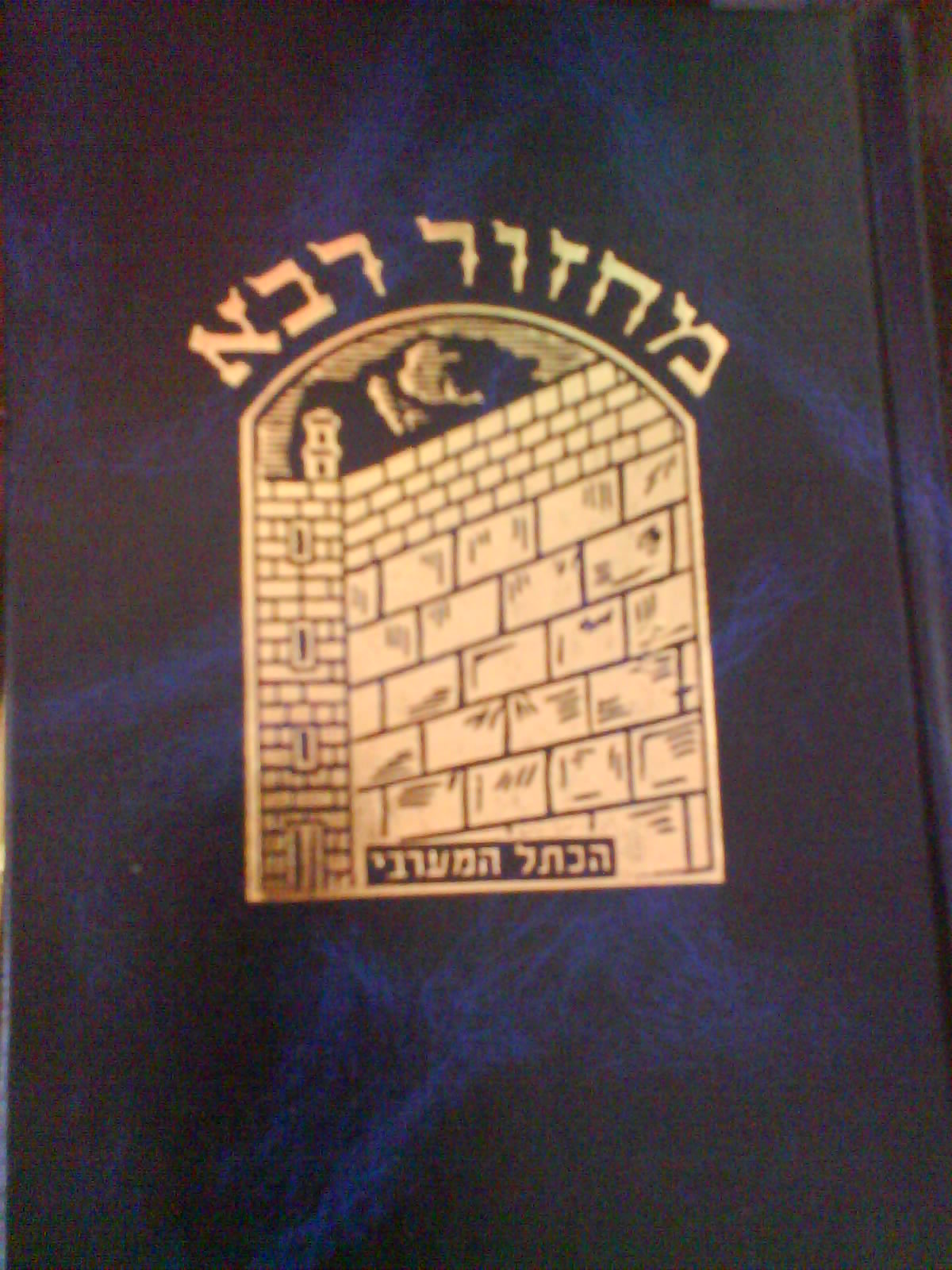
My new Machzor for Yom Kippur

The "Noam Elimelech" I purchased.
Photos: Miriam Woelke
Sunday, September 4, 2011
True Prayer
B”H
How does a person know whether his service to G – d is absolutely true and selfless ?
When the person praying remains humbled after his prayer. Even if he prayed with the highest concentration, he shouldn’t show off in front of others and think that he is special.
________________________
Thursday, July 28, 2011
Is it allowed to pray while wearing CROCS ?

B"H
The halachic question whether it is allowed to pray wearing CROCS is extremely interesting to me. I am a CROCS fan and mainly wear those funny looking shoes.
KIKAR SHABBAT was asking the question if a Jew may pray in CROCS and the answer is YES. A praying Jew may wear CROCS but, at the same time, should also wear socks.
Haredim and barefoot is always an issue. Once a friend of mine was praying at the Kotel (Western Wall) only wearing sandals. She didn't wear socks but was barefoot. A haredi woman came up to her and said that she (my friend) shouldn't be praying liked that (without socks). My friend, however, considered herself as "national religious" and for her, this was excuse enough.
Thursday, July 14, 2011
Jewish Morning Wake Up Mitzvah
Remark: It is mostly Chassidim having a bowl filled with water next to their bed in order to wash their hands in the morning. However, there are plenty of religious Jews who wake up, say MODEH ANI right after opening their eyes and then go to a sink in order to wash.
According to the Kitzur Shulchan Aruch, MODEH ANI may be said without washing one's hands before prayer.
Saturday, April 9, 2011
Rabbi Chaim Soloveitchik on the SHEMONA ESREI
B"H
Rabbi Chaim Soloveitchik has a brief but very significant comment on the Kavanah (concentration) of the SHEMONA ESREI prayer (Amidah):
While praying SHEMONA ESREI we should be aware that we are really standing in front of the Creator ! It is not just another prayer where we need the ordinary Kavanah but a special intention.
Sunday, January 2, 2011
REINCARNATIONS in Talmud & Prayer
B”H

Exhibited Kabbalah picture in Zfat.
Photo: Miriam Woelke
Just recently I wrote about REINCARNATIONS and that the whole concept is part of Judaism.
Reincarnations as well as further kabbalistic teachings such as the “Sefirot” (Keter, Chochmah – Wisdom, Bina – Understanding, etc.) are anything but an invention of some Jewish medieval Kabbalists. Those ideas have been already put down in the Talmud and great Rabbis such as Rabbi Akivah were very much aware of the secret teachings of the Torah.
This is what KABBALAH is: The hidden content in the Torah. Content which is not revealed to us unless we learn it with a teacher (a Rabbi).
Kabbalah is being divided into two levels:
- The Theoretical Kabbalah
- The Practical Kabbalah.
Once again, Rabbi Akivah knew very well how to use the practical Kabbalah. Just look at the Talmudic story when he and his friends went into the “Pardes” where only Rabbi Akivah himself came out. The others either died, lost their minds or became totally secular. Meaning that one has to be on an extremely high level in order to deal with the practical Kabbalah.
Moreover, in order to deal with the Jewish Kabbalah, one must be Jewish, as the Jewish soul is involved. A Gentile with a non – Jewish soul is unable to connect to Jewish Kabbalah. Rabbi Yitzchak Luria already refers to this in his days and if Madonna was learning his real writings then she may come to the conclusion that her studying Jewish Kabbalah is nothing but in vain.
It is also said that it was Rabbi Akivah hiding the practical Kabbalah, as too many people started using it for evil negative purposes. As far as we know, the false Christian Meshiach, the Jew J., was one of those using the Kabbalah for his own purposes and not for the good.
Furthermore, we learn from prayer that there are reincarnations in Judaism. Look into the “Bedtime Shema - Kriat Shema la’Mitah” – first paragraph “Ribono shel Olam”.
Every night before we go to bed, in “Ribono shel Olam” we forgive other people for treating us not that nicely on this particular day.
“Master of the Universe ! I hereby forgive anyone who has angered or vexed me, or sinned against me, either physically or financially, against my honour or anything else that is mine, whether accidentally or intentionally, inadvertently or deliberately …
… bejn be’shogeg bejn be’mesid bejn be’dibur bejn be’ma’aseh bejn be’GILGUL (REINCARNATION) zeh bejn GILGUL acher…
There are Jews who undergo different reincarnations and should not be punished for their wrongdoings against me in this reincarnation and not in the next.
Thursday, October 14, 2010
Go deep inside of you before Prayer
B"H
Devekut (concentration) in prayer doesn't only come by itself. One has to work on himself until he is fiannly able to climb up the ladder leading to higher and higher prayer levels.
So, you are standing there with your Siddur and you are about to start praying. How do you actually do this ? It is time to pray or you feel like getting closer to G - d and here you are. Should you just open the Siddur and start reading the verses. Meaning: Praying.
The Chabad Rabbi Mordechai Siev said in a lecture this morning that prayer needs preparation because we are getting our three soul levels (Nefesh, Ruach and Neshama) involved.
Remark: I am not going into the subject of the other two higher soul levels Chaya and Yechidah.
We start our prayer here in the present material world and only afterwards try to climb a little higher. The lowest soul level (Nefesh) stands for the natural (animal) soul within us. Meaning: Running after our wordly desires such as food, drinks, sex, movies, money, etc. Moreover, Nefesh is connected to the Wold of Action and, thus we advance prayer by getting up, saying blessings, washing our hands and learning some Torah.
This way we are getting into a prayer mood and arising our emotions. Emotions, on the other hand, stand for the second world, the World of Emotions meaning the next soul level RUACH. The third soul level is Neshama and we are influencing the level of our Neshama with the actual prayer.
A prayer has the task to influence our behaviour and actions after the prayer in a positive way. However, first we have to prepare ourselves on different levels until we finally climb up the level ladder.
The best way for meditation is actually taking a Sefer and starting to study some Torah, a commentary or some spiritual writings. What one should not do is starting his whole path into Yiddishkeit only with spiritual matters. You can fly around as much as you like but ask yourself what you are actually doing. Our material world is the world of action. G - created us because He wants us to deal with this world including worldly matters. The question is how we combine our Jewish identity into our daily life.
Rabbi Siev gave a great practical example:
A newly married couple is going through all the Sheva Berachot after the wedding. For seven days, the groom is treated like a king and the bride is treated like a queen. However, after those seven days of celebrations are over, suddenly the queen is telling the king to take out the garbage. Then the real marriage work has begun and nothing is only spirituality, love and romance but reality and daily life.
______________________
Everything may sound so "terribly" Chabad but let me tell you, hardly any other Orthodox Rabbi would tell you something different.
Wednesday, September 1, 2010
Prayer Doubts
B"H
Many years ago, when I was looking for my way into a religious life, I used to go crazy about certain ideas. I had forgotten about one particular episode but I suddenly remembered when I read some commentaries on the month of Elul this morning.
Especially some prayer content used to bother me in the past because I felt that I couldn't say certain sentences within some prayers. For instance the famous sentence in the morning prayer "Shacharit" when we thank G - d for having us created. Men usually say that they are grateful for not being created as a woman whereas women say that they are grateful of being created in the image of G - d.
Of course, it is upsetting and confusing when you look at the sentence men say. "Not being created as a woman" sounds like having a disease. I asked a few Rabbis and we females were told that a man is simply grateful not to be created as a woman because as a male he is able to do more Torah Mitzvot such as Tefillin or any Mitzvah not limited by time.
It is not strictly forbidden for a woman to put on Tefillin but today's custom is not to do so. However, a woman is time limited and thus free from many Mitzvot. At least those women with a family and children. There are "Mitzvot she Hazman Grama" and when a woman has to take care of her children, she cannot sit down and start praying all parts of the morning prayer. She cannot appear at the Synagogue due to feeding a baby, etc. This would be meant when a man is thanking G - d for not having him created as a woman.
I used to have many questions and was constantly searching for clarification. The problem was finding a, for me, sufficient answer.
It says that in the present month of Elul we Jews have to do "Cheshbon Nefesh". Go into ourselves, get aware of your sins and regret. In connection with the intention of trying to do everything better in the future. Nevertheless, "Cheshbon Nefesh" is not only reserved for the month of Elul but we have to be aware of our sins throughout the whole year.
It says in the Chabad book "Shaarei HaMoadim" that we cannot concentrate on all our sins every day because this may bother us to advance in finding a closer relationship to G - d. We cannot just think and regret but have to look forward and study Torah and actually do positive acts. The book refers to the "Kriat Shema - Bedtime Shema" we say every night before we go to sleep.
I remember the days when I was convinced that I would never ever say the first paragraph of the Bedtime Shema because I wasn't able to. When you pray something you should have in mind to keep it but who is able to forgive any person who has offended you during the day ? Many times I don't forgive such a person in the evening and I will not do so for a long time. Why then should I say so every day in the Bedtime Shema ? What I finally decided on my own was to leaving out the first paragraph.
Today, when I am forgetting the Bedtime Shema or fall asleep before, I do say the paragraph but still have my doubts because what I am saying is not always true.
Sunday, December 13, 2009
FREE Artscroll Downloads
B"H
Interesting FREE Downloads (Tehillim - Psalms and further prayers) can be found on the ARTSCROLL site:
http://www.artscroll.com/itehillim.html
Interesting FREE Downloads (Tehillim - Psalms and further prayers) can be found on the ARTSCROLL site:
http://www.artscroll.com/itehillim.html
Sunday, November 22, 2009
What is more important: Work or Prayer ?
B"H
We have a new baker at the bakery. He has only started to work a few days ago but a new problem is already coming up:
The new worker is national religious and is supposed to start at 6am. He claims that he can only start later, as he wants to say his Shacharit (morning prayer) together with a Minyan (10 Jewish men) in a Synagogue.
My question is: What is more important ?
Going to work on time and keeping the job or prayer ?
The bakery does have a solution for him: First of all, he has time for Shacharit until 10am or so. Secondly, there is a Synagogue (of Rabbi Mordechai Sharabi) right behind our building and he could quickly jump over to pray. There is no point in showing up for work too late when the goods have to be baked on time.
Anyone has the right halachic advice (incl. source) ?
Sunday, November 8, 2009
Special Prayer for Rabbi Mordechai Eliyahu

B"H
Tomorrow, Monday, there will be a special prayer for the former Israeli Sephardic Chief Rabbi Mordechai Eliyahu. The prayer is going to take place in Jerusalem's neighbourhood Kiryat Moshe, Reines Street 17.
The Synagoue is Rabbi Eliyahu's Synagogue and the service is due to start at 2pm with Tehillim (Psalms) followed by Selichot at 3.30pm.
Women are welcomed !
Rabbi Mordechai Eliyahu has been suffering from an illness for a long time.
Sunday, July 26, 2009
"Tikun Chazzot" with the Erloi Rebbe
B"H
Great pictures showing the Erloi Rebbe praying a "Tikkun Chazzot - Soul rectification at Midnight" at the Kotel (Western Wall). The special prayer took also place due to the Shabbat opening of the municipality praking lot "Karta".

 See the haredi "Yahadut HaTorah" politician Me'ir Porush sitting in the front row to the right.
Photos: Chadrei HaCharedim
Wednesday, June 17, 2009
The latest Pakshivilim
B"H
 Sunday, 29 Sivan, Erev Rosh Chodesh Tammuz: Special prayer at the Kotel (Western Wall). Outcry to G - d in order to help us and not let any government succeed in forbidding us to build in our own country.
 The former Sephardi Chief Rabbi and spiritual leader of the SHASS - Party, Rabbi Ovadiah Yosef: "The Internet is impure !"
Subscribe to:
Posts (Atom)



