Showing posts with label Philosophy. Show all posts

Sunday, November 4, 2012

Having a meaningful Jewish Life from different Aspects

B"H 

We wish to be inscribed in the Book of Life, but it should be a life we wish to be in rather than one that we seek to escape from. 

We pray not only for life, but for quality of life that is meaningful and purposeful, one that will be lived for the greater glory of G – d. 
-----------------------

Source:

"Growing Each Day" by Rabbi Abraham J. Twerski


The religious definition for "having a meaningful life" probably is "leading a life according to the Torah Mitzvot". Many religious Jews may say: "Purposeful = Keeping Torah Mitzvot and thus doing the will of G – d". 

Nevertheless, I do have my doubts whether keeping Mitzvot is leading all kinds of Jews to a meaningful life. "Meaningful" in the sense of each individual. Moreover, I do claim that not every Jew is meant to run after all Mitzvot. 


In the Galilee

Photo: Miriam Woelke

It has nothing to do with selfishness but there are Jews who consider their life as meaningful when they put all their energy into being creative. Others have a career in high-tech, business, science or administration. There are Jews who regard their lives more meaningful when setting up their own business rather than going for Shacharit, Mincha, Tehillim and Ma'ariv. 

It is possible to connect being creative and having a career with keeping Mitzvot and I am not saying that Jewish professionals don't keep Mitzvot. However, running after Mitzvot may not be the main focus in those people's lives but rather focusing on their profession and putting the Torah inside of their (professional) output. 

Wednesday, April 18, 2012

The KUZARI and Greek Philosophy


The KUZARI - Sefer HA'KUZARI by Rabbi Yehudah HaLevi

Photo: Miriam Woelke
B"H

Until today, Rabbi Yehudah HaLevi, is one of the most famous Jewish poets and philosophers. He used to live in the "Golden Age" of medieval Spain. At a time when the Muslims were still reigning the country and very much supporting intellectual studies. On the other hand, leading Christians did the opposite in northern Europe, as they tried to keep their citizens uneducated. Spain under Muslim rule was flourishing and for hundreds of years, Jews enjoyed their personal intellectual freedom. 

It was Rabbi Yehudah HaLevi writing the famous KUZARI in the early 12 century. In general, the book is about the king of the Khazars (a people which really existed around the 8 century). The king is searching for a new religion for his people and thus invited a Jew, a Christian, a Muslim and a philosopher in order to see which one of them has the best reasons believing in his theology. In the end, the Jew wins and the entire people of the Khazars converted to Judaism. 

It is true that the Khazars converted to Judaism but historians claim that the story Rabbi Yehudah tells in his book is nothing but a fairy tale. In real, the Khazars had different reasons to convert and it had nothing to do with an angel appearing to King Bulan. 

Rabbi Yehudah HaLevi, however, saw a necessity in writing the book, as, in his days, Greek philosophy of Socrates, Plato and Aristotle became popular among intellectual circles. Rabbis had to act in order to prevent Jews from leaving Judaism and following Greek philosophical ideas. 

Greek philosophy shows quite a few differences to Judaism. First of all regarding the creation of our universe. Greek philosophers thought that the universe has always been in existence. Judaism, however, believes that G - d created any existence from nothing. Furthermore, the Greeks regard the human intellect as something extremely important and only by being intellectual, one is able to have a relationship with the creator. A theory the Rambam (Maimonides) later discussed in his "Guide for the Perplexed – Moreh Nevuchim". Just like Rabbi Yehudah HaLevi's KUZARI, the Rambam's "Moreh Nevuchim" consists mostly of philosophical discussions. The Rambam like to use Aristotle as an example and quotes him plenty of times. 

The KUZARI is the Jewish response to Greek philosophy as well as Karaite ideas. The Karaites mainly spread in the very early Middle Ages as well as in the days of Rabbi Yehudah. Already Rabbi Sa'adia Gaon wrote against Karaite ideology. Basically, Karaites believe in the written Thora but not in the oral law. On Shabbat they sit in the dark, as they don't prepare any light in advance. Furthermore, the Karaites have a problem with Olam HaBah and the etrenal existence of the Neshama. Rabbis felt like they had to act and prepare a response. 

The KUZARI is a unique and great response to the Karaites as well as to Greek philosophy fans. The book points out Jewish basic believes but the reader has to have a knowledge about Greek philosophical ideas. It is not enough that one is sitting around being so terrible intellectual when he doesn't do anything else. In Judaism, a Jew has the task to fulfill Torah Mitzvot in order to have a relationship with G - d. Judaism is a religion of doing / acting. 

One doesn't just read the KUZARI but studies the book carefully. With all kinds of commetaries and, if necessaries, for years. I have been trying to do so but, unfortunately, my time is limited. However, those who want to understand and appreciate the content of the KUZARI won't get around studying Greek philosophy too.

Wednesday, October 5, 2011

Why do bad things happen to good people ?

B"H

A few thoughts on Yom Kippur

If G - d is good, then He wouldn’t want bad things happen to good people, and if G - d is omnipotent, He could prevent bad things from happening to good people. Therefore, when bad things do happen to good people, we wonder if G - d is really good or omnipotent, or whether He exits at all. 

Ten Explanations 

1. We can predict that more intelligent beings will often to things that less intelligent beings won't understand. 

2. The suffering might not be caused by actual evil, but a perfectly fine circumstance which this person is responding to irrationally. 

3. The circumstances might not be a punishment but rather an opportunity to grow (a test). 

4. The difficulties might be just a means to push someone towards a wonderful circumstance. 

5. In many cases, what seems like evil at the hand of G - d might be evil at the hand of man. 

6. We might not appreciate the value of a kindness or the seriousness of cruelty. 

7. Since the only fair reward is based on effort, not on objective accomplishment, then a good G - d might send obstacles to maximize our effort and consequent reward. 

8. A person might be given to stimulate them to rethink their plans or past behaviour -- as sort of wake - up call. 

9. There are times when progress towards history 's - successful - conclusion necessitates supernaturally limiting the success of the righteous. When they are supernaturally handicapped, that allows forces of evil to become more manifest. People then realize more clearly what it means to live with evil, and choose good -- not out of fear of punishment, but out of clarity about the difference between good and evil. In the end days, in order to accelerate us the final outcome (of man choosing good), G - d thus accentuates the choice. 

10. Reincarnation (Gilgul) 
______________________________

(Text from Yeshivat Aish HaTorah)

Tuesday, August 31, 2010

The World was created in Tishrei

B"H


The Talmud Tractate Rosh HaShana 10b teaches that Rabbi Eliezer said that the world was created in the "Jewish" month of Tishrei. However, this statement would only refer to the creation of mankind (Adam HaRishon and Chava) but not to the creation of the world itself. The real birthday of the world, so to speak, is five days earlier: On 25 Elul (this Shabbat).


Talmud Rosh HaShana mentions disputes about the true month of creation. One Rabbi claims that it was Nissan, others say it was Tishrei. One explanation of solving this dispute is the opinion of the Ohr HaChaim (any many further commentators) that G - d thought about a creation in the month of Nissan and in Tishrei or Elul, He took action.


The Gemara (rabbinic discussions) in Rosh HaShana 11a asks: "From where do we know that the world was created in Tishrei ?"
Answer: For it is stated:


And G - d said - Let the land be covered with vegetation - herbage yielding seed, trees of fruit.


This verse implies that at the moment of creation the fields were already covered with vegetation, and the trees already laden with mature fruit.
This is implied in the phrase "be covered with vegetation", which suggests a land thickly overspread with mature vegetation, and in the words "trees of fruit", which connote trees laden with mature fruit (Rashi and Maharsha).
And which month a tree is laden with mature fruit ? In Tishrei.

The Gemara in Rosh HaShana 11a brings a proof:
The newly created world required rain and, indeed, rains fell and plants came forth as it is stated:


And a mist arose from the earth
and watered the whole surface of the soil.

We see that creation took place at the rainy season, which comes in Tishrei.

__________________________

There are many further opinions / commentaries on that Talmud teaching. As a matter of fact, the real meaning of the entire creation process is not known to us. We can interpret the Torah content on the subject but our mind just cannot grasp of what G - d did, why and how. How create our whole universe from NOTHING ? Only creating with THOUGHT !
I think it was Aristotle (described in the "Moreh Nevuchim - Guide for the Perplexed" of the Rambam) who claimed that something had existed before creation and that this something was used in order to create our universe. 


What was G - d doing before He created the world including us humans ?
I don't understand the famous statement that He created us, the world, the Jews, in order to show His kindness. It rather sounds like a weak excuse for having to say "I don't know ".  

Monday, July 12, 2010

Once the Rabbis studied Philosophy and Science


From today's "Yediot Acharonot"

Photo: Miriam Woelke


B"H

Parts of Israel's haredi (ultra - Orthodox) society has been questioning its own education system for years. There are Haredim who would like to go tand study at a university; become a doctor or a scientist but Israeli universities don't accept anyone with a Talmud Torah or Beit Yaakov degree. Haredi schools don't teach too much; the girls, however, learn still a bit more than the boys but not enough to enter the academic world.

Last night, the haredi radio channel "Kol BaRamah" referred to the haredi education problem and Knesset member Eliezer Moses (Chassidut Vishnitz) as well as the Meretz politician Horowitz were interviewed. Even Rabbi Moses admitted that most Haredim today have no basic knowledge in general education let alone in science. The left - winger Horowitz said that all Israelis need a basic knowledge in order to find a job.

I am the opposite of Meretz but, in this case, Horowitz is right. Just look at Rabbi Kook, the Vilna Gaon, the Abarbanel, the Rambam, the Ramban or the last Lubavitcher Rebbe. They all studied science and philosophy. Today, many Rabbis claim that philosophy would take religious people away from religion. However, G - d provided each of us with a special talent and we should use it. Why should a haredi woman not 
become a doctor ? Why an Israeli Haredi not a physician ?

People are usually not led away from religion but to me it looks as if certain Rabbis are only interested in keeping their power.

Monday, January 11, 2010

The Surface of the Sun


B"H

One of the most popular philosophical questions is whether there is a G - d. Can there be a G - d with all the mess and disasters on earth ? Do we humans tend to look for a higher being in order to find some kind of orientation ? Are we just looking for an image in order to put a piece of meaning into our lives ?

The most popular answer among the Baal Teshuva movement is:
"Only us waking up in the morning is a proof that there is a G - d. Look at the stars, the moon, the sun, the entire universe. Who keeps everything alive ? 
Only G - d is able to do so".

The argument may sound a bit too easy. Enough to please Baalei Teshuva but could it really be true ?

Why not ?

In my free time (if there is any) I have been dealing as much as I can with astronomy. I am not one of those standing everywhere with a telescope but I do surf around the net and have a look at NASA or further scientific sites. By dealing with this kind of subject, I became more aware of what our universe means. How vulnerable it is and what an amazing level or perfection it must have taken to create it. By studying about the planets, the atmosphere and chemical elements in space one can easily come to the conclusion that this can only function because there is a perfect Creator (G - d).

Our planet was perfectly designed for us humans. Where else could we live ? Maybe on Mars but this is not as easy at it seems.
Planet Earth was created with a special atmosphere for us. A shield protecting us from meteorites and debris from space. We have water, air and food. Where else do you find this in the whole universe ?

Can everything just be an accident ? 
A Big Bang without any cause or goal ?

Tuesday, December 1, 2009

Franz Rosenzweig

Judaism is not the acceptance of a doctrine, of a religion and its rituals. It is the experience of a pre-existent reality, which has its ultimate basis in Israel's "being with the Father", in the election of Israel. There may be times when this reality is obscured by the manifold and colorful reality of the nations among whom the Jew lives. But even hidden, it remains real and mysteriously active, and there may come a time when the blessed gift, the heavy burden of its confirmation, is bestowed upon those born into it.
Continue reading HERE !
B"H

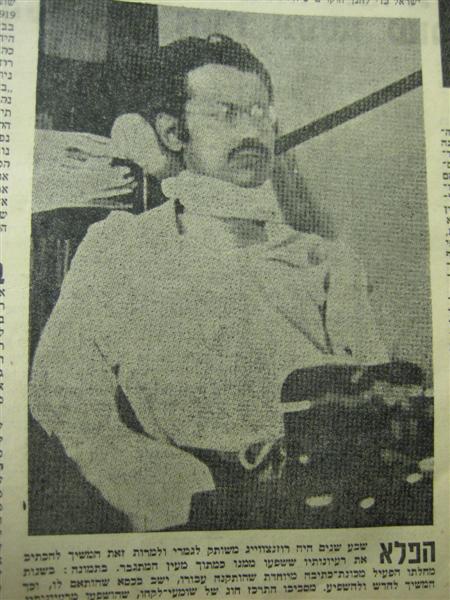
I found two old pictures of the German Jewish thinker Franz Rosenzweig,1887 - 1929, on the site of the Chadrei HaCharedim.


For seven years, Franz Rosenzweig was completely paralyzed but his wife Edith Hahn was able to read his thoughts and wrote everything down he transmitted to her.

Tuesday, June 30, 2009

Is Achmadinejad getting the Finger ?

B"H

For a few days now, the below left pictures has been making its round through the TWITTER world. Most people understand the gesture with the finger as a joke. Obviously the pictures was photoshopped. The picture on the right side, however, is supposed to be the original.


Further information on PDN !


Photoshopped yes or no, I like the joke !

Thursday, January 15, 2009

The RAMBAM and the Intellect


"Moreh Nevuchim - Guide for the Perplexed"

B"H

The Rambam (Rabbi Moshe ben Maimon, Maimonides) was born in Cordoba / Spain in 1135. He was one of the greatest Torah scholars we ever had in Judaism. Furthermore, he was an expert in physics, was a philosopher and medical doctor.


Rabbi Moshe ben Maimon (1135 - 1204)

In his "Guide for the Perplexed – Moreh Nevuchim" we can find him as a philosopher. On the one hand, the Guide serves Jews getting some understanding of the symbols of the Torah but at the same time, the Guide is written for highly intellectual people understanding the hidden messages in it.

After a highly productive life, the Rambam died in 1204, and was layed to rest in Tiberias in northern Israel.
Many times we hear a claim that the Rambam actually converted to Islam when the Almohad (a radical Islamic group) invaded Spain. However, this claim was never confirmed and a conversion of the Rambam seems to be very unlikely. Why would he then call Mohammad a madman ?


The grave of Rambam in Tiberias


The "Guide for the Perplexed" was originally written in Arabic and caused lots of criticism in those days. The book was even banned or burned. The main reason for the ban was the Rambam quoting the Greek philosopher Aristotle. How could someone dare quoting a Greek philosopher and confirm some of his opinions (e.g. creation of the world) ? On the other hand, the Rambam also proves Aristotle wrong in many further issues. Not all of Aristotle's statements went hand in hand with Judaism.

Throughout the entire Guide, the Rambam always comes back to his main issue:
the INTELLECT.
G - d gave us all the intellect so that we may use it in the best and highest way we can. It is the intellect making us different from an animal. Our intellect enables us to differ between Good and Evil. Man can perfect himself by using his intellect and the more intellectual a person is, the more likely he may receive prophecy. The Rambam claims that prophecy is only given to perfected highly intellectuals. Those statements are rejected by a later Jewish philosopher from the 14th century; by the famous Chasdai Crescas.
According to Crescas, nothing depends only on the intellect of an individual but G - d created all of us out of love. And wouldn't all those ideas about the intellect leading people away from taking the Torah Mitzwot seriously ? Doesn't a high intellect only become an excuse ? Just like: "If I have enough intellect, I am automatically closer to G - d".

Despite all the bans and book burnings, the Guide became one of the most famous and most studied Jewish book. Besides the "Mishna Torah" and other works, the "Guide for the Perplexed", once again, shows the greatness of the Rambam.

Sunday, January 11, 2009

Change in kabbalistic Thought after the Expulsion from Spain (1492)

B"H

In our times, we always think of the coming of the Meshiach as something having to do with the future. With our behaviour, with our capability of rectifying the world and overcome our own Yetzer HaRah (evil side within us). Something futuristic.

Everyone says that the Meshiach isn't too far anymore. He is almost here and we are already in his footsteps. Especially as we get closer to the Jewish year 6000 (now we are in the year 5769).
The Talmud Sanhedrin regards the year 6000 as the year of Meshiach. It is rather funny because in the same paragraphs (Passukim), the Talmud warns not to make any predictions about the days of Meshiach.

These 6000 years stand for the six days of Creation. "And G - d rested on the seventh day". The year 7000 will be the time of Meshiach, the time of rest.

After the expulsion of Spanish Jewry in 1492 through King Ferdinand and his wife Isabella, the Jews were in a state of shock. This shocking experience also found its way into kabbalistic thought.
Don't forget that for many centuries, the Jews in Spain had a great life. Philosophy, Kabbalah, poetry, everything was blossoming and was suddenly brought to an end. Not so suddenly but still surprisingly. What a great Jewish life was there in Spain ? The Rambam (Maimonides), the Abarbanel, Rabbi Moshe De Leon (Zohar), and all those famous Kabbalists. After the expulsion, the Kabbalah became more and more messianic. The shock was deep and people wanted Meshiach now. The same as we today !

However, the Kabbalists in those days changed their way of thinking and didn't see all those future Tikkunim (rectifications) as that important for bringing the Meshiach. They rather decided to go back to the source: to the time of Creation.
Retracing the path that leads to primordial beginnings of Creation and revelation and thus maybe return a unity and purity of the beginning of the Creation process.

In my eyes, those thoughts are rather interesting. Especially because today we hear so much about all these futuristic ideas. It could be that I just had enough of those and like the idea of something else.
The Kabbalists in those days loved to experiment with Kabbalah and caused new ideas. This is what we need today. Some really religious Kabbalists having the courage to invent something, not necessarily new, but cause some different aspects.
__________________

Source:

Gershom Scholem in "Major Trends in Jewish Mysticism"

Wednesday, December 3, 2008

The Cause

B"H

There are things in religious society which really cause me to freak. And yesterday was another moment when I almost blew up.

I came into our bakery and overheard a short conversation with some religious female employees. One of them told me that she had been to the funeral of the Chabad couple (Gabriel and Rivka Holzberg z"l) and she continued with mentioning "Lashon HaRah - idle gossip".

"What does Lashon HaRah have to do with the funeral ?" I asked.

"Well, she replied, it is all because of Lashon HaRah. All the Jewish suffering, everything. We have to do Teshuva."

I don't know if this is another typical Sephardi idea. Sephardic Jews are very much into handing out red ribbons in order to prevent the "Evil Eye - Ayin HaRah" from someone. Furthermore, their Rabbis (but also Ashkenazi rabbis) announce from time to time that Jews not checking their Mezuzot or Tefillin may cause personal catastrophes. If there is one letter missing or half disappearing, the Mezuza or the Tefillin is not kosher anymore. It is the Mitzwah of every Jew taking care that these items have to be checked from time to time. If not, who knows what is going to happen to the household.

Now the whole terror attack or the killings in the "Chabad House" just took place due to Lashon HaRah. Don't ask me where this was announced or which Rabbi decided so.

I said to the two Sephardic female workers that no one knows why things happen in this world; only G - d knows everything. We humans tend to make guesses as soon as their are incidents we are unable to grasp. Then we immediately start looking for solutions or explanations.

Why can't we just let it go ? It happened and, obviously, G - d had His reasons. Why do I have to invent a reason in order to understand tragedies ? Doesn't it bother people when suddenly some ideas appear of "I don't know what" rabbis ? How do they know G - d's reason ? Have they ever received His confirmation for such individual speculations ?

Sorry, but it is making me just sick when I hear such conclusions.

Friday, October 10, 2008

Why do bad things happen to good people ?

B"H

For me, the easiest and most convenient way to "survive" Yom Kippur is the participation in a program. Therefore, almost every year I go to AISH HATORAH in order to participate in their program. Mutually run by the Heritage House and Jeff Seidel's Jewish Student Information Center.

This year, the program was great. The best, however, were the participants themselves, as we had great classes and great questions and remarks. And, as usual, the same question came up:

"Why do bad things happen to good people ? Why do I suffer and not my evil neighbour ? Why does G - d do this and doesn't choose someone else ?

Here an article on the subject which a few thoughts from the previous year ?

If G - d is good, then He wouldn’t want bad things happen to good people, and if G - d is omnipotent, He could prevent bad things from happening to good people. Therefore, when bad things do happen to good people, we wonder if G - d is really good or omnipotent, or whether He exits at all.

Ten Explanations

1. We can predict that more intelligent beings will often to things that less intelligent beings won't understand.

2. The suffering might not be caused by actual evil, but a perfectly fine circumstance which this person is responding to irrationally.

3. The circumstances might not be a punishment but rather an opportunity to grow (a test).

4. The difficulties might be just a means to push someone towards a wonderful circumstance.

5. In many cases, what seems like evil at the hand of G - d might be evil at the hand of man.

6. We might not appreciate the value of a kindness or the seriousness of cruelty.

7. Since the only fair reward is based on effort, not on objective accomplishment, then a good G - d might send obstacles to maximize our effort and consequent reward.

8. A person might be given to stimulate them to rethink their plans or past behaviour -- as sort of wake - up call.

9. There are times when progress towards history 's - successful - conclusion necessitates supernaturally limiting the success of the righteous. When they are supernaturally handicapped, that allows forces of evil to become more manifest. People then realize more clearly what it means to live with evil, and choose good -- not out of fear of punishment, but out of clarity about the difference between good and evil. In the end days, in order to accelerate us the final outcome (of man choosing good), G - d thus accentuates the choice.

10. Reincarnation (Gilgul)


(Text from Yeshivat Aish HaTorah)

Tuesday, August 19, 2008

Back to the Source – The Age of the Universe, Part 2

B"H

As already mentioned in PART 1, the kabbalistic book "Sefer HaTemunah" estimated the age of the world of 42.000 years at the time when Adam was created. Rabbi Yitzchak of Akko (1250 – 1350) wrote in his book "Ozar HaChaim" that those 42.000 years are not to be understood according to human terms but as g – dly years. According to plenty of Midrashic literature, ONE g- dly day stands for 1000 human years (see also Sefer Tehillim – Psalms). And one g – dly year with 365,25 days stands for 365,250 earthly years. Therefore, Rabbi Yitzchak of Akko concludes that our universe is 42.000 x 365,250 years old. The result of this multiplication is 15.349.500.000 years. Today, NASA and scientists estimate the age of the universe of about 14 – 15 billion years. And now look at the calculation of Rabbi Yitzchak of Akko. Already 700 years ago, he came to the same conclusion which tells us that we are not more intelligent than the people in the Middle Ages.

Every time we study the first chapter of the Book of Genesis (Bereshit), we are always amazed by the unusual longevity of the Generation of the Flood (with Noach). And as usual, there are different opinions saying that those years of the Generation of the Flood were much shorter than our years today. After the Flood, nature changed and due to the impact of the Flood, even the orbit had changed and countries and continents faced slightly different locations. Man's life expectance had also changed, although people could still live up to hundreds of years. Furthermore, illnesses came into existence which hadn't been the case before the flood. Before, people just died after hundreds of years but they didn't die because they were sick. They just dropped dead when their time had come. No illnesses were known in the time before the Flood.
Until the times of Avraham, people also didn't age. We know about they famous Talmudic story of Avraham and his son Yitzchak who looked alike because no one was aging.

The first mentioning that the years in the Torah were shorter was Josephus. And Josephus gave a few reasons why the Generation of Noach live for such a long time. First of all, they lived closer to the time when the world was created and because G – d loved them. In those days, G – d's influence and Shechinah (presence) were much more visible than today. Until the Flood, the people were vegetarians and there was no pollution or poisoning fields and forests. Nutrition was healthy because everything was pure without any pollution. The Generation of the Flood ate plants and drank water or sometimes milk. The Ramban (Nachmanides) comments that those people were a perfect biological creation and this is the reason for their longevity. Today, our DNA is much different from those former generations.

All changes after the Flood are considered by the Sages as a g – dly punishment. Following generations were supposed to take the events as a warning but they failed to do so. Just the opposite; everything and each generation got worse. The Flood was a warning but more than 300 years later, the Tower of Bavel (Babylon) was built. Another disaster.

The Flood could only occur because G – d Himself changed a star constellation (see Talmud Rosh HaShana 11b – 12). The average lifespan before the Flood was 929 years and afterwards 445 years. After the Tower of Bavel, the years were diminished once again down to 228 years. According to Jewish literature, mankind is getting back longevity in the days of Meshiach (see Isiah – Yeshayahu 65:20). The we will reach the age of 900 plus.

I want to mention that there are many many opinions on the days of Meshiach, the Resurrection of the Death and what is going to happen, how and the results of it. In the next article, I am going to list various different opinions but it should be very clear that no one knows for sure what is going to happen.
Only G – d, as usual.

Sunday, July 13, 2008

Jews don't need a Medium

B"H

The famous Greek philosophers Aristotle and Plato wrote in detail about G – d, the fate of the world and about the creation process. Plato's theory was that there had to be a so – called "third man" working as a medium between G – d and His creation, as G – d could not directly communicate with His creation (men) and vice versa.

The later Jewish philosophers Philo and Shlomo ibn Gvirol took over Plato's theory and added their own ideas and concepts. Shlomo ibn Gvirol, for instance, regarded the divine will as a kind of medium communicating between G – d and His Creation. However, not all the Jews at the time of Philo as well as of Shlomo ibn Gvirol accepted the ideas of these two philosophers. But not only in the past were their concepts widely rejected; also today the Platonian concept doesn' t have too much in common with the fundamental believe of Judaism.

Why ?
One of the foundation of Judaism is the idea that Jews don't need a medium in order to communicate with G – d. Him and us are totally able having a direct connection and thus personal relationship. Without any medium and abracadabra a la Harry Potter.

Christian society has its fundamental believe in a G – d who is also human. And especially the Christians welcomed the concepts of Philo and Ibn Gvirol. No wonder, as they used those philosophical ideas for their own purposes called a somehow G – d with human character traits. However, Judaism demands from Jews to use their individual human intellect. Each of us is able to have a direct relationship with G – d. But how are we able to do so, as G – t is an absolute infinite being and we are unable to grasp Him ?
G – d let us know His will in the Torah and by doing Torah mitzwot, we are able to build up a connection with Him. Therefore, we don't need a medium or anything in between Him and us. This is one of the great things in Judaism.

On the other hand, this way of "directness" brings us to the conclusion that there is an individual and a collective punishment. Jews don't only undergo an individual punishment but also a collective one. Example: If we don't act according to the Torah, G – d can cause not to let it rain in Israel or He could cause new conflicts with our enemies. The only way we can change His decree is by doing Teshuva (repent). But we don't need a medium or a human G – d.

Nevertheless, you could argue that there are Jewish concepts where other Jews are referred to as a kind of medium.

1. The role of the Zaddik (righteous) in Chassidut.

Isn't there a chassidic concept claiming that the Zaddik has special powers and furthermore builds a connection between G – d and His creation ? Only the Zaddik has the power to elevate the world and do certain rectifications (Tikunim).

2. Why do Jews travel all the time to the Kivrei Zaddikim (graves of the Zaddikim) such as our forefather, foremothers or famous Rabbis (Rambam or Rabbi Yitzchak Luria) ? Once I came to the grave of the Rambam (Maimonides) in Tiberias and saw several Sephardic Jews jumping onto the tombstone and praying and kissing it wildly. Can we use the Rambam in order to speak for us to G – d ?

I would have a lot to say about these two issues but I keep it short.

First of all, I don't agree with the absolute Zaddik concept in Chassidut. All of us are only humans; humans with strong and weak character traits. And so does the Zaddik. Moreover, there are also different controversial opinions about the role of the Zaddik in Chassidut. Rabbi Yaakov Yitzchak Horowitz (the Seer of Lublin), 1745 – 1815, as well as his teacher, Rabbi Elimelech of Lejansk, extended the role and importance of the Zaddik. Formerly, the Baal Shem emphasized the role of a Zaddik but not as much as his successors. And it is not only me disagreeing with the unlimited power and importance of the Zaddik. Already the former student of the Seer, Rabbi Yaakov Yitzchak Rabinovicz of Przysucha (Yiddish: Peshis'cha), 1765 – 1814, opposed the fundamental Zaddik concept of his teacher and later on founded his own movement. The Peshis'cha movement where such famous groups like Gur, Biale, Rimanov, Kosnitz or Sassov come from.

Not everyone agreed and agrees to the importance of the Zaddik concept and especially today the question "who is a real Zaddik" is raised. Which chassidic Rebbe has the real status of an honest Zaddik ? And today, one opinion became very famous: "The Rebbe is not necessarily a Zaddik anymore but he is the son or grandson of a true Zaddik".

Regarding the visit of the graves of Zaddikim:
It could be that there is a special higher power at the gravesites of the Rambam or Rabbi Yitzchak Luria. Despite the Jewish concept that G – d is everywhere at the same time and with His same power. However, the best example for a higher Kedusha (holiness) is the Temple Mount in Jerusalem. Even when the Temple Mount is in the hand of Gentiles, as today, G – d never withdrew from there and is going to bring the full power of the place back as soon as Meshiach is coming.

Nevertheless, a visit to the Rambam's grave doesn't mean that he will be on my side and solve all my problems. I have to deal with G – d myself and don't need the help of a medium. Never forget the advantage of having a personal relationship with G – d and this makes us as important as all the Zaddikim together.
At least to G – d.

Tuesday, July 1, 2008

You cannot touch G – d

B"H

Until the foundation and spreading of Christianity and Islam as well as Karaite theories, Jews never thought about the concept that G – d could be corporeal and / or might have human character traits.

Especially Christianity loves to understand the Torah literally. Far too literally and without taking into account that there could be a deeper inner meaning within the text, let alone metaphorical meanings. There are plenty of hidden messages in the Torah and we cannot take everything literally. The Torah is full of metaphors such as "G – d's arm, G – d is angry, G – d enjoyed the smell of the offerings …"

Somehow this fact has always been very clear to Jews until the Christians came and falsely turned around the meaning of the Torah. This was simply more convenient for them.

Some time later, the great era of Islam started and the Muslims accused the Jews of believing in a corporeal G – d. The early Islamic book, "The Kalam" became very popular among Muslims and there it states that Jews have the wrong understanding about G – d.

By the way, in Judaism as well as in Islam, G – d doesn’t have form or matter. In both religions He is incorporeal.

The Rambam (Maimonides) explains "The Kalam" in detail and lengths. His book "Moreh Nevuchim – The Guide for the Perplexed" is an answer to the accusations in "The Kalam" and for others who don't understand the metaphoric language of the Torah. Everyone should study the "Guide for the Perplexed" although it is anything but easy. If you have the book, you should preferably study it with the Abarbanel – commentary.

The intention of the Rambam was to prove and clarify the Jewish believe in an incorporeal G – d. In Judaism, G – d is an eternal being without any form and matter. Or in other words, a being we cannot grasp with our limited human understanding. We already have problems understanding the term "eternal". What is "eternal" ?
We don't know. The longest we can live is up to 120 years and therefore, what do we know about eternity ?

If you just have a brief look at the "Guide of the Perplexed" you will see a book without any order. It is rather confusing and all contexts are mixed. Many times the Rambam even contradicts himself. Many people mistakenly draw the conclusion that the "Guide" is a philosophical book. However, the book is actually a Jewish book; for Jews who are not afraid to think.

A short example:

Already at the beginning in Genesis (Bereshit), the Torah tells us about Seth (third son of Adam) and that he was the first in his (Adam's) image. How then did Cain and Abel (Hevel) look ?
Many commentators explain that they rather had an animal like shape. The Rambam, on the other hand, gives a very precise and logic explanation.

In order to be regarded as an "animal", one doesn't need to look like one. It is already enough when a human being behaves like an animal. I am regarded as an animal when I don't use my G – dgiven intelligence, mind and thoughts; when I don't make positive use of my abilities but rather hang around without doing anything. G – d gave us abilities and a mind, and exactly this is the meaning of this particular Torah verse. Therefore, Seth was the first after Adam, using his intelligence and abilities in a positive intelligent way.

Conclusion: Cain and Abel (Hevel) weren't running around as animals but simply didn't make use of any of their brains in the right way.

Thursday, June 26, 2008

Questions & No Answers

B"H

Just like everyone else, I am also having plenty of questions regarding religion. And many times I have been, and I still am, totally unable to find any answers which would satisfy me. However, I keep on searching, as no one should ever give up hope.

There is one particular concept in Judaism which is bothering me a lot. Not that I am constantly thinking about it but when it comes to the point, I do start thinking. Actually there are two concepts bothering me and I will start explaining the second one first. Hopefully I am succeeding in connecting the two subjects. My thoughts do not mean in any way that I don't believe in those concepts or that I have any doubts. On the contrary, because I do believe in them I am having my own thought.

Number one bothering me: Certain statements concerning Meshiach in Talmud Sanhedrin and Halachot. Many commentators, Kabbalists and Philosophers provide us with further explanations and details. According to most statements, we will all be on a higher soul level after the arrival of Meshiach. We won't do anything wrong anymore, hence no more sinning. The only thing we are going to do is fulfilling the will of G – d.

So, what bothers me about that ?

Maybe "bothering" is the wrong formulation but for me personally, it it extremely hard to imagine not having any more Free Will. I admit that life is much easier and convenient when there won't be any more evil in the world and therefore, we don't constantly need to distinguish between good and evil. There will be only good and this is it. There won't be any more negative character traits after the arrival of Meshiach. In the end, everything will be good and this is the ideal goal and purpose.

Okay, so everything is only good. But what about my Free Will ? Am I suddenly a Zombie due to the fact that I am only doing G – d's will and nothing else ?

Do I sound egoistic by only looking at my Free Will ?
Maybe but according to my understanding, G – d created us with a Free Will in the first place and why does He suddenly need us only to act as He wants ?

On the other hand, aren't we obligated to do everything He wants from us ? Wasn't it Him who created us and the whole world ? And isn't it us depending upon Him because we couldn't exist without Him ?

But why did G – d provided us with a Free Will in the first place ? Why did we first have the ability to distinguish between good and evil ?

According to Kabbalah the whole purpose of Free Will is to use it for a Tikun Olam (complete soul rectification). By keeping Torah Mitzwot we are making the world a better place and introducing higher moral and religious standards which eventually lead us to the arrival of Meshiach. But does the "final output" Meshiach at the same time means that we are going to loose our Free Will and that we are transforming into a puppet – on - a – string ?

No Rabbi, Philosopher, Talmid Chacham or Kabbalist is able to define the Jewish concept of Free Will. What does Free Will mean and how far does it go ? Where is its beginning and its end ?

The Talmud teaches us that G – d knows everything. He knows the future, the present and the past. He knows our thoughts and many say that He knows exactly what kind of decisions we are going to make. How far does G – d influences our Free Will without us even realizing it ?

And here we come to the second point bothering me.
Talmidim Chachamim including the Rambam (Maimonides) argue about the question how much Free Will humans really possess. Some say that we don't have any Free Will at all and that what we think is our Free Will turns out to be just an illusion. G – d decides everything and therefore He also determines my thoughts and my actions.

Let's just briefly assume that G – d determines everything and we don't have a Free Will.

Why then do we sin ? If He determines our actions, shouldn't we then be perfect and on an amazing high religious soul level ? Why do we still sin ?

And if He determines everything, why are we held responsible for our actions ? Every criminal could just claim that it wasn't him doing anything wrong but G – d made him do so. And why should we be punished for our negative actions if G – d made us do so ?
And what about me, the small tiny individual ? What am I ? Am I simply a guinea pig or puppet and only G – d is pulling the strings ?

For us humans it turns out to be much more positive when we have the feeling of total freedom. If is only up to us making a distinction and decision between good and bad deeds. Between leading a life according to the Torah or not. If not, would I at all be a human being and not only a puppet ?

The perfect chassidic answer to this is that everyone has to have faith in a G – d who, on the other hand, does everything for the good. Consequently, we don't have any right questioning His reasons / actions because our limited human intellect couldn't grasp His thoughts anyway. And this is exactly the answer Rabbis giving me to my questions. And if not this kind of answer then that we simply don't know. How should we know, as G – d has never informed us.

As I mentioned at the beginning, I don't have any doubts about the Meshiach and Free Will – concept. However, it still gives me a very strange feeling to know that one day (in case I will see the Meshiach), I will be on a level where I am only doing G – d's will. In a way it seems frightening. A fear of loosing freedom and the individual personality.

Some might claim that exactly this is our main purpose of creation and being. Nevertheless, I am still having problems to know that I might live without a Free Will and not asking myself if I am doing the right or the wrong thing. No wonder that the Hollywood movie "The Matrix" was so extremely popular among orthodox Jews. The more Torah we study, the more we are interested in receiving answers to all our questions. Not necessarily about the purpose of our whole being, as the Rambam explains in his book "Moreh Nevuchim – The Guide for the Perplexed (chapter 13)", but rather the question of how far G – d really influences our lives.

The final conclusion is that there is no answer but only speculations and opinions. And the only thing we can do is keep on guessing because only G – d can definitely answer all our questions. A G – d who is totally unknown to us and we cannot even grasp.


Links:

The Jewish Meshiach Concept - Part 1

The Jewish Meshiach Concept - Part 2

Wednesday, June 25, 2008

Philosophy in Chassidut ?

B"H

Although I like the haredi world and admire certain people, I still always remain reluctant when it comes to a certain subject called "education". Looking at a haredi school's curriculum scares me away.

Despite all criticism, different haredi groups and directions have changed the curriculum to the better. Al least the girls' school curriculum. Example: the Vishnitzer Chassidim.
They, for instance, started teaching their girls English. This is already something, at least in Israel where English among Haredim is not to be taken for granted. If you speak to a Gerer Chassid (male or female) or to someone from Toldot Aharon in English, then you have a language disaster coming up if you don't know Hebrew or Yiddish. Those Chassidim don't know any English unless they are from the States or England.

The Haredi world, or in other words, Litvishe and Vishnitzer Chassidim decided to teach English to the girls and the reason seems obvious. Girls are becoming wives and many wives have to earn the family's income. Especially Israeli high tech companies are looking for haredi women in order to employ them. Working in the high tech field is good money but the applicants have to know English. And here you have the reason.

I am not generalizing haredi education and there are groups offering more and better education than others. Especially the Batei Yaakov in England and the States are much more advanced and efficient than in Israel. But what I do criticize are certain subjects definitely belonging onto a curriculum. Such as higher math, physics and other science and especially history and philosophy.

Chassidim, however, always seemed to have a problem with philosophy; even with Jewish philosophy. Rabbi Nachman of Breslov was probably the most fundamental opponent of philosophy. Until today, Breslover Chassidim don't really study the Rambam's famous book "Moreh Nevuchim – The Guide for the Perplexed". It is strange because Chabad (Lubavitch) does exactly the opposite and Chabadnikim love the Rambam.

There was no real Jewish philosophy until the time of Raabi Saadia Gaon (9th – 10th century). The reason for a missing philosophy was that there was simply no need for it. Many years before, the Jews had lost their Second Temple and leading rabbis had been extremely busy putting together the Talmud and further laws in order to ensure the survival of the Jewish people living in the Diaspora. Only when Islam started to rise and the Karaites proclaimed their strange ideas, Judaism was forced to react and provide answers. And Rabbi Saadia Gaon was then the greates opponent of the Karaite movement. He wrote several books and succeeded in destroying all their claims and arguments. He alone won all the discussions and disputes.

As I mentioned before, the chassidic movement under the Baal Shem Tov wasn't interested in philosophy. Philosophical questions and ideas, rationality, reasoning … all this doesn't fit into a world of Kabbalah and total spirituality. And Rabbi Nachman emphasized the concept of the "Simple Jew" with faith.
One has to see G – d everywhere and, although His reasons and thoughts are not ours, we have to accept His actions.

Jewish philosophy is very diverse. You can find poems, laws, Torah texts or even Aristotelian ideas. Rabbi ibn Da'ud and his successor, the Rambam (Rabbi Moshe ben Maimon) are the first discussing Aristotelian ideas and comparing them to Judaism. Aristotle had a similar picture of G – d; that there can only be one G – d ruling over everything.

Not all thesis are welcomed in the haredi world. Rabbis fear that their communities could be let astray. Someone studying philosophy should have reached a certain age and be strongly observant. I am sure that different Rebbes do deal with philosophy but keep it far away from their Chassidim. The only group teaching lots of philosophy are the Chabad Chassidim, as they consider themselves to be the most intellectual chassidic group. And just have a look at the "Tanya" of the Chabad founder, Rabbi Shneur Zalman of Liadi. The "Tanya" consists of plenty of philosophical as well as kabbalistic ideas and concepts.

Unfortunately, I don't know too many Haredi dealing with philosophy. I actually do know some Vishnitzer Chassidim doing research on how far Judaism was influenced by non – Jewish philosophical ideas. A very interesting but complicated subject. And, unfortunately, not too many haredi students today know about Rabbi Saadia Gaon, Rabbi Yehuda HaLevy or Rabbi Shlomo ibn Gvirol.

Tuesday, June 24, 2008

Dead without a Trace

B"H

The Mishna in Talmud Shabbat 151b teaches that "whoever closes the eyes of a dying person at the moment of death – is a murderer".

Even if there is no hope that a person is going to survive, the eyes should only be closed after a while and not immediately or, Chas veChalilah, seconds before the actual death.
The Talmud raises the question if closing the eyes too early wouldn't hasten the death of the particular person. Can you imagine that you are still alive and then someone is coming and closing your eyes ? Just like "Oh, he or she is going to die anyway. So, what does it matter and have a nice day".

The great commentator Rashi states that the early closing the eyes of a dying person can hasten his death. One should wait an appropriate length of time before closing the eyes, since the "dead" person may in fact not yet be dead but merely unconscious (see the Mishna Torah of the Rambam, Hilchot Aveil 4:5).

Further details concerning closing the eyes of a dead person can be found in the Shulchan Aruch – Yoreh Deah 352:4.

I am anything but a Posek (halachic expert) but exactly this Mishna immediately came into my mind when I heard about the Israeli Chief Army Rabbi planning to declare the two kidnapped soldiers, Ehud Goldwasser and Eldad Regev, as "fallen soldiers with unknown burial place".

Actually this week, an exchange of hostages should have taken place. The two Israelis against the Lebanese terrorist and murderer Samir Kuntar and four other Lebanese war hostages. However, according to the the Israeli Chief Army Rabbi the exchange could be unnecessary, as we don't know if the two soldiers are still alive. And therefore, he might declare them as "fallen soldiers with unknown burial place". Of course, the families of Ehud Goldwasser and Eldad Regev are furious and planning to complain at the Supreme Court.

Not only concerning the "Goldwasser – Regev case", the question arises if we shouldn't always hope for the best as long as there is no clear evidence ? Giving the benefit of a doubt even if the situation and reality seem to appear hopeless. Or should we just give up and acknowledge the facts ?

I think that the Mishna in Shabbat gives us an answer.
Someone giving up hope too early is a murderer. In the case of the two soldiers, only two years have passed. On the other hand, DNA and other blood analyses have prooven that at least one of the soldiers must have died before or shortly after the kidnapping. But who can tell anything for sure ?

The great halachic expert, Rabbi Moshe Feinstein, once decided in favour of Holocaust survivors whose spouses vanished in the Holocaust. His halachic decrees can be studied in his books "Iggerot Moshe". Anyway it would be interesting to have Rabbi Feinstein's opinion today. Unfortunately, we don't.

The decision the Army Rabbi is maybe going to make might be based on reality. Nevertheless, should not everyone consider humanity as well ? Isn't especially humanity more important in this case ? How should the families keep their hope in order to deal with the situation ?

Of course, the relatives of the two soldiers have to be realistic as well and face the facts, but isn't it especially hope keeping us alive and let us manage the worst situations ? No matter how.

Sunday, May 25, 2008

The "Epistle of Martyrdom"

B"H

Whoever is looking for philosophy in Judaism shouldn't leave out the writings of the Rambam (Maimonides). His "Moreh Nevuchim - Guide of the Perplexed" or his Epistles, for instance.

The Rambam himself was born into a time of catastrophes and he is giving us a great example how Judaism is able to survive any bad times. Rabbi Moshe ben Maimon, the Rambam or Maimonides, was born in Cordoba / Spain in 1135. At that time, the town was reigned by the Muslims but years later, Spain was overrun by the Almohad (Al Muwahhidun). Originally the Almohad came from Marocco which they had conquered first. Today you can compare the Almohad to the terrorist organization Al Khaida; Muslim extremists killing anyone not obeying their rules.

It goes without saying that the Rambam and his family didn't intend to convert to Islam and for them a time of restless wandering began. In 1160, they finally ended up in Fez (Marrocco). From there they made their way to Egypt.

Until today, Muslims like to claim that the Rambam converted to Islam. There is no proof whatsoever for this claim. However, I cannot imagine that a person like the Rambam would convert to Islam. But let's just assume that he did, why then did he call the Muslim Prophet Muhammed a "madman" ? At least three times, the Rambam called Muhammed by this name in his "Iggeret Teman - Epistle of Jemen".

He probably wrote the "Epistle of Martyrdom" in 1165; shortly after his family left Fez for Egypt. The Epistle consists of advice how to get away or survive the mass conversions to Islam. How the Jews of Spain should react to the danger of the Almohad. According to the Rambam, Jews who were forced to do Avodah Zarah (idol worship) didn't do anything wrong and are not to be called "Rasha - Evil".

Rambam's advice:
Neither worshipping idols in public nor should anyone feel any joy by doing so.
But didn't Esther (see Megillat Esther) didn't worship idols in public ?
Yes, but she was more or less passive.
Rava commentates: There is a big difference between doing idol worship with personal joy or without.

Desecrating G – d's name is the severest sin a Jew can do. No other sin is mentioned in the Torah as many times as the "issur of idol worship". And G – d even adds that there is hardly any Teshuva for it. If a Jew, on the other hand, sanctifies G – d's name, he will be rewarded.

The Rambam suggested that the Jews should leave a town or village as soon as they were oppressed. The reason for that he found in the Torah when Avraham left his father Terach in order to follow G – d's will. The Rambam sees in this Torah Passuk a proof that a Jew should separate himself from people who don't really walk in the path of Torah.

After the Almohad took over Spain, they demanded from the Jews to proclaim in public that there is no G – d but Allah and that Muhammed is his prophet. This was the only thing the Jews were supposed to do and the Almohad didn't require any mass conversions to Islam. However, this proclamation had to be made in public and according to Halacha, this is a big problem.
In the Middle Ages, religion and politics were totally connected with each other. Religion was not a privat matter but decided about one's social and political status. Furthermore, Judaism, Islam as well as Christianity claimed to be the only inherit of the true tradition. Each religion saw itself as the true pathway of G - d. A person belonging to one of these religions automatically denied the claim and the truth of the other two. Islam accused the Jews of erasing Muhammed's name out of the Torah and considered Ezra guilty of doing so. Jews should finally admit that their parents and grandparents followed the wrong believe – that the Torah is unique and eternal.

Maimonides (the Rambam) decided that any kind martyrdom of Spanish Jewry under the reign of the Almohad was unnecessary.
As we know, Jews who are forced to do certain sins such as sexual perversion, eating non – kosher food or worshipping idols, should rather commit suicide than following the demands of the oppressor. However, the Rambam decided that in this case no consequences were necessary. Other rabbis, on the other hand, stated just the opposite. Until today people claim that the Rambam rather favoured a political decision than a halachic one.

As the Almohad didn't force the Jews to obey the laws of Islam and the Jews were thus able to continue with their Torah mitzwot, there was no reason to assume that Islam would cause any damage to the Jewish communities. Therefore, the Jews could give in.
Furthermore, the Rambam didn't see any contradiction to the Jewish believe and the unity of G – d. These two factors played an immense important role in his decision. He was even willing to tell the Jewish communities to follow the orders of the Almohad and not to let anyone commit suicide. In his epistle he made it very clear that their situation was very complex and unique. It was a special situation but, on the other hand, he didn't deny the fact that suicide could be a choice. But, at the same time, the Rambam was against a "suicidal solution". Instead he favoured a solution where the Jews should be calm and wait until the whole thing would come to an end. Rushing into a suicide would definitely not be the right solution dealing with the situation. And rushing into suicide would be absolutely against any Halacha. He also made it very clear in his epistle that all Jews suffering under the Almohad would do a great "Kiddush HaShem – Sactification of G – d".

_____________________________________

From the book "Crises and Leadership" by Halkin / Hartman

Thursday, May 22, 2008

Why this was and not that way ?

B"H

"Why this way and not that way" ? - This is the question we keep on asking throughout our lives. "Why did G - d create the world in such and such a way ? If I was G - d, of course, I would have done something else. And why don't get bad people punished immediately ?"

G - d created us and the world according to a perfect plan. He didn't want us to be robots which just act according to one will. Instead He created us with a "Free Will" and the "Free Will - Concept" must include positive and negative sides. There has to be good and evil in this world because otherwise we wouldn't have a choice. We can choose between secualr, religious, G - dfearing or the opposite. What kind of a person do we want to be ? Good or evil or something in between ? It is all up to us.

Of course, He could have created us as perfect human being but obviously this wasn't His plan. And would bad people receive their punishment instantly, where would be our Free Will ? We see someone getting punished and, of course, we won't do the same mistakes as he did. So, we do G - d's will out of fear but not out of love, Devekut, etc.

But doesn't G - d still sometimes interfere ? There are times when we have a certain plan in life and want to make it real. Then, however, everything seems to go just wrong. You could see this as a hint from G - d. Maybe He knows that this is not the right path for you and wants somehow make you aware of your mistake. Other people simply see the difficulties as a challenge. A challenge from G - d to work harder and not to give up.

"Free Will" is one of the most important concepts in Judaism. Nevertheless, according to some opinions like the Ishbitzer Rebbe, we do not have a Free Will. Everything is up to G - d and we only do what He wants and estimates. This leaves us with the question if this opinion couldn't be used as an excuse ? Anything we do wrong was planned by G - d and it isn't really my fault. Those are very philosophical questions and, so far, I haven't met anyone who could determine Free Will. Where does it start and where does it end ?

Maybe we should all use our Free Will and think it over for some time.