Showing posts with label talmud. Show all posts

Tuesday, July 31, 2012

Sium HaSHASS in Jerusalem

B"H

Every seven years, the cycle of studying the entire SHASS (Daf Yomi of the Talmud) is finished. Such a Sium is always a big event and thousands of Haredim were on their way to different celebration places in Jerusalem yesterday. 

Here are a few pictures in order to give you an impression:


See all pictures HERE !

Thursday, March 22, 2012

Eruvin 13b: "About Prominence and Success"

B"H

Whoever searches for prominence, prominence flees from him. But whoever flees from prominence, prominence searches for him. And whoever forces time, time forces him. But whoever yields to time, time will eventually halt for him.

Talmud Eruvin 13b

Saturday, February 11, 2012

Saturday, January 28, 2012

Talmud Chagigah 12a: Adam HaRishon

B”H 

The Talmud Tractate Chagigah 12a teaches that Adam HaRishon (Adam) reached from one end of the earth to the other. 

Explanation:

Like many Aggadic statements these measurements are not meant literally. Rather, the Gemara refers to the measure of mind. Adam’s mind was able to comprehend all that was from one end of heaven to the other and all that was between heaven and earth.

Monday, January 16, 2012

Talmud Avodah Zarah 2a

B”H 

There are times when I get really caught up in certain study matters. I would like to give you one example from a few years ago, where I had a special question and in order to find an answer, I asked all kinds of people and searched through any Talmudic commentary you can imagine. Eventually a Litvishe Jerusalem Kollel sent me an interesting answer. 

For those who are interested: It is necessary to have a bit of Talmudic understanding ! However, I am going to continue the subject in order to confront you with further Talmudic commentaries. 

My question to the Kollel was: 

The Mishna in Masechet Avodah Zarah / Amud 2a is talking about 3 days before the idol – worshipper’s holiday where you should not do business with them. 

According to Tosafot, the Yerushalmi and the RAMBAM (Mishna Torah), the in the above mentioned Mishna OVDEI KOCHAVIM are only in Eretz Israel and abroad they are called (Shomrei) MINHAG AVOTEIHEM. 

Could you please explain what (Shomrei) Minhag Avoteihem means, as, so far, I haven’t found a proper answer. 

If people in Chutz La’Aretz follow the Minhagim of their fathers, isn’t it Avodat Kochavim or idol – worship too ? What is the difference ? 

And here is the response from Rabbi Sigler:

Minhag Avoteihem be’Yadeihem means that they don’t take their religion very seriously – they are just going through the motions. What this means practically is that – for example – meat from animals that they slaughtered is Mutar be’Hana’a (it’s not kosher but we can feed it to our dogs) because they did not have their idol in mind when they slaughtered it (Talmud Tractate Chullin 13a). It does not mean that what they do is not considered idol – worship and that they are permitted to do it under Noachide law. 

Ovdei Kochavim in Eretz Israel take their religion more seriously but, according to the Gemara (Chullin 13b), not seriously enough to be considered Minim. A Min is someone who is Aduk (mentally attached) to his particular idol – worship (Rashi). Meat from an animal that he slaughters is Asur be’Hana’a (forbidden to derive any benefit from) because we assume that he slaughtered it in the name of his idol. Therefore, even in the times of Chazal only a small minority of non – Jews were bonafide idol – worshippers. The rest – even in Eretz Israel – were going through the motions to one degree or another.

Saturday, January 14, 2012

A save place for your Money

B”H

The Talmud Tractate Bava Metziah 42a discusses where a Jew should put his money. Imagine you are looking for a secure place for your money, where would you hide it ?

One of the talmudic answers is that the best way of guarding one's money is to bury it in the ground. However, most commentators state that a secure place for money depends on the time where a person lives. In ancient times, burying the money into the ground may have been a great hiding place but today this sounds a bit odd. The great Posek Rabbi Moshe Feinstein stated that in our days, money should be put into a bank. An honest working bank where we won't suffer from any losses. 

Wednesday, December 7, 2011

Is a kosher animal slaughtered by a Gentile kosher ?

B”H 

There may be cases where Jews enter a Muslim butcher store with the intention of buying some meat. Especially in those areas where there is no Jewish store available. While living in Germany I said to myself that it is better buying sausages in a Turkish store where there are no pork ingredients than in a regular supermarket. I used to live in Nuremberg / Fuerth and there was simply not kosher store, whatsoever, around. The next kosher stores are in Frankfurt or Munich. 

The question comes up whether the meat of a kosher animal slaughtered by a Gentile is kosher. KOSHER according to Jewish Halacha.

The Talmud Tractate CHULLIN teaches us exactly how a kosher animal should be slaughtered in a Jewish sense. Among others, what kind of knife the Schochet (ritual slaughterer) should use and that the knife should not have a damages. The cut has to take place within a second and a damaged knife may cause the animal to suffer. In such a case, the meat won't be kosher anymore. After the ritual slaughter, different organs of the animal are being checked in order to find out whether the animal may have been sick. The Talmud has very strict rules about what is kosher and how to slaughter an animal. 

What about a Gentile who sticks to the Jewish Halacha and schaechts a kosher animal such as a cow or a chicken ?

The Talmud Tractate Chullin 13 says that such a precedure would not produce kosher meat. A slaughter done by a Gentile is invalid even if the animal itself was kosher. Although Muslims don't eat pork, they still do not slaughter the animals according to Jewish halachic standards. 

Sunday, November 6, 2011

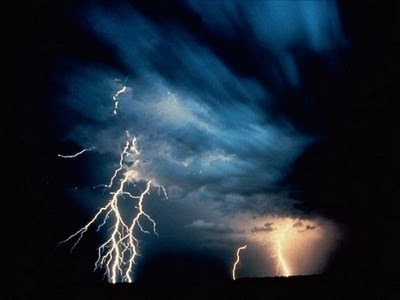
Lightning & Thunder

B”H 

Judaism has special blessings for lightning and thunder: 

Lightning: ….Oseh Ma’aseh Bereschit 

Thunder: …she Kocho u’Gvurato maleh Olam 

As soon as we see a lightning or heard the first thunder, we say those blessings. In case the two appear together, we only say …Oseh Ma’aseh Bereschit. 

The Talmud Tractate Berachot (Blessings) 59a asks what exactly causes thunder or even an earthquake. The answer of the following Gemara (rabbinic discussion) is that the causes are either G - d's tears, G - d clapping His hands, G - d putting his foot down or pushing His feet under His throne

It goes without saying that the Gemara is here using symbolic language ! 

Rabbeinu Chananel interprets the Gemara: Noise is an expression of G - d's satisfaction that the Jews are still in exile (Diaspora). G - d would love to bring them back to Israel but the time has not yet come. 

Although expressions such as “G – d's Feet” etc. cannot be understood literally but symbolically, the deeper meaning is that G - d may cause nature catastrophes in order to teach us something. Giving us a hint that we should find our way back to Him. This may sound like something weird apocalyptic but the Kabbalah as well as the Talmud give proof this theory. Let us take the generation of Enosh when G - d was punishing the people due to their idol - worship practices. Suddenly parts of the mainland disappeared into the sea and became part of it.

Wednesday, November 2, 2011

The Vilna Gaon on Talmud Shabbat 10a

B”H

Talmud Shabbat 10a teaches:

A person should not stop learning Torah in order to pray because his prayers are not effective.

The Vilna Gaon, Rabbi Eliyahu ben Shlomo Zalman Kremer (1720 – 1797), suggests the following interpretation of the Talmudic statement: 

If a person doesn’t want to listen to a Torah teaching because he has already heard it, so, too, G – d will not accept his prayers because He has already heard them. 

Once I was sitting next to a person at a Shabbat meal where a Rabbi just gave a Torah teaching. The person next to me said that he doesn’t need to listen, as he has already heard the same teaching before. When I told him the interpretation of the Vilna Gaon, the person immediately started to listen to the Rabbi.

Tuesday, September 6, 2011

Seven Days without a Dream

B”H 

Not only the Talmud but already the Torah has a wider section on dreams. Just look at the dreams of Yaakov, the dream interpretations of Yosef and Paraoh’s dream. All those Torah portions we read during the month of Kislev (December / January) and, in a kabbalistic sense, KISLEV is the month of sleep and dreams. The Talmud Tractate Berachot is providing us numerous dream interpretations. 

The same tractate, Daf 14, teaches that Rabbi Yonah said in the name of Rabbi Ze’ira: 

“Anyone who sleeps for seven days without having a dream is called “evil”. 

What does this statement mean and why am I an evil person when I don’t dream for seven days ? 
Is it my fault not to have a dream ? 

The Vilna Gaon, Rabbi Eliyahu ben Zalman Kremer (1720 – 1797) gives us an answer where he compares the seven dreamless days to the seven days throughout a week when a person doesn’t necessarily think about his purpose in this world. When someone is too busy realizing that our entire existence is only temporarily. The Vilna Gaon said that this world is like a dream because it doesn’t last. Instead of wasting his time with unnecessary things, a person should try concentrating on getting an appropriate place in Olam HaBah (the world to come). Those people who rush through the six work days of a week do have an excuse because they are busy earning their living. On Shabbat, however, the person should try to grow spiritually. People not realizing their purpose of existence and just wasting their lives can be called “evil” because they, in a way, ignore creation. This is why the Vilna Gaon uses these two comparisons. Nothing is eternal and this world can be like a dream with our life vanishing within a second.

Thursday, June 16, 2011

Talmud Shabbat 88: G - d covered the Jews with Har Sinai, Part 2


The Sleeping Beauty Galaxy

B"H

See PART 1 HERE !

Although we find different Talmudic and Rabbinic statements that G – d was forcing the Jews to accept the Torah on Har Sinai (Mount Sinai), there are many other opinions. The famous commentator RAN, Rabbi Nissim of Gerona, for instance, said that the Jews had to accept the Torah in order to receive Eretz Israel. Thus, the Torah was their ticket to Israel.

When the Jews lived in the first Babylonian Diaspora after Nevuchadnezzar had destroyed the First Temple, many Jews thought that the Torah lost its validity. Why keeping Torah laws when they are not in the LAND anymore ? In fact, many Jews got accustomed to Babylonian idol – worship practises and assimilated because they didn’t see any future for the Jewish nation. The Land was gone and so was the Torah. Why then not be like all the other nations ?

However, after the severe incident with Haman and the Purim miracle taking place, the Jews found back to their roots. Unfortunately, not all Jews were prepared to move back to Israel when Ezra got the chance to take them back. Also here, assimilation was still a subject despite the miracle of Purim. The Talmud Tractate Yoma teaches us that only a small percentage of the Jews finally returned in order to rebuild Jerusalem and the Temple. Most Jews remained in Babylon, as they saw their businesses growing and weren’t interested in moving back to a devastated place. Those Jews moving back to Eretz Israel promised not to forget the Torah anymore and it should be valid for all future generations. 

The Talmudic Rabbi Resh Lakish compared the six days of creation to the 6th of Sivan. The day when the Jews received the Torah at Har Sinai. Rashi stated that the sixth day of creation actually refers to the 6th Sivan. A Gemara (rabbinic discussion) in the Talmud Tractate Shabbat 88a teaches that THE EARTH BECAME FRIGHTENED AND, IN THE END, GREW CALM. What does this mean ?

Says Rashi: The earth became frightened due to the reason that the Jews may not accept the Torah and, as a result of this, G – d would destroy His entire creation. However, the Jews did accept the Torah on 6th Sivan and the earth calmed down from its fear.

The Ramban (Nachmanides) commentates that the world was created in a way that the Jews would accept the Torah. Otherwise G – d would have destroyed His creation, as the whole purpose for creating the world had vanished. No purpose = No more creation.

Saturday, April 16, 2011

Earthquakes and Thunder in the Talmud

B”H

The Gemara (rabbinic discussions) in the Talmud Tractate Berachot 59a lists various reasons why earthquakes take place. The Spanish commentator RASHBA (Rabbi Shlomo ben Aderet, 1235 – 1310), however, understands the text in the Gemara not as a reason for earthquakes but for THUNDER. Thus, the RASHBA is asking what is causing thunder. Does G - d really clap in His hands or stamping his feet ?

This Talmudic statement of G – d making noise with His feet or hands reminds me of the old Germanic people who believed that their God Donar / Thor is making noise in heaven by rolling around his wagon. 


Although the Gemara is giving the reason that G – d is clapping His hands or stamping his feet, these examples are not to be taken literally but symbolically. What we have to do is recognizing the deeper meaning behind this symbolic language. The Tunisian commentator Rabbeinu Chananel (Rabbi Chananel ben Chushiel, 11th century) explains that G – d uses loud noise in order to express His dissatisfaction that the Jews still live in the Diaspora. He (G – d) would love to lead them back to Israel but the time has not yet come.

The Rashba added that thunder is a nature occurrence. During Temple times, when the Jews fulfilled G – d’s will, there were no heavy storms although they are caused by nature. Of course, there was rain but only as much as was needed and no floods or catastrophes. Thunder, however, was meant to cause a Jew to do Teshuva (to repent). 

When G – d creates a rainbow after rainfall, it is a sign that no further flood will befall the world. After Noach’s Flood, G – d made a promise (Brit) to Noach not to bring about another flood covering the world. The world but G – d could bring about a flood destroying a country. The rainbow is part of nature but G – d chose using nature occurrences in order to express His dissatisfaction with humans. 
____________________________

I don’t really understand the Gemara. Earthquakes may take place when the Jews don’t go according to G – d’s will. Maybe even when the other nations don’t show a proper behaviour. G – d uses nature occurrences in order to make us think and review our behaviour, as nothing in this world happens without a reason. No quake, no thunder, no tsunami, etc. Nevertheless, I don’t think that it is right when certain Rabbis point their fingers at other people and claim they know the reason why this and this happened. Of course, we can guess and maybe make a suggestion but we should never forget that we don’t know G – d’s true intention.

Wednesday, March 16, 2011

Leaving an animal at an Inn


B”H

The following teaching from the Talmud Tractate Avodah Zarah (Idol – Worship) 22a seems to fit into ancient times but may not really apply today. Nevertheless, I find it quite interesting.

The Mishna (oral law from Mount Sinai) teaches that a Jew should not park his animal (donkey, camel, horse, etc.) at an inn of a Nochri (Gentile) innkeeper, as the innkeeper may get attracted to the animal and rape it. The prohibition is leaving the animal alone with the Gentile. Some Rabbis, on the other hand, claim that the Mishna here speaks about a Gentile innkeeper taking care of the animal of his Jewish guest.

Sounds strange ?

Sex with animals sounds rather common when we look into ancient daily life and desires. Even Bilam had sex with his she – donkey (see Talmud Sanhedrin).

Wednesday, March 2, 2011

Queen Esther and her Niddah Status

B”H

The Gemara (rabbinic discussion) in the Talmud Tractate Pesachim 111 discusses the result of a woman walking between two men. On condition that this particular woman is a Niddah. Meaning, she is having her monthly period.

Especially haredi circles keep the Halacha that a man should not walk / pass between two women. No matter whether they are in Niddah or not. As far as I know, this particular prohibition comes from the Talmud.

The Gemara in Pesachim 111, however, teaches that a woman being a Niddah should not walk between two men and that Queen Esther was a Niddah when she gave the dinner for Achashverosh and Haman.

The Gemara says that when a woman is in her monthly Niddah status and walks between two men, a tragedy is supposed to happen. If the woman is just beginning her Niddah status, one of the men may die. If the woman is walking between two men towards the end of her Niddah status, the two men may end up in a quarrel.

The famous Vilna Gaon stated why Queen Esther invited Haman when she was planning a nice dinner with her husband Achashverosh. At this particular dinner, she intended to convince her husband to cancel the deadly decree against the Jews. Neither Achashverosh nor Haman knew that Esther was Jewish. But why did Esther invite evil Haman ? Wouldn’t she have had more success by only talking privately to her husband ?

The Gemara in the Talmud Tractate Megillah 15a teaches that Esther instantly became a Niddah after hearing about the evil decree against the Jews. Three days later she invited Achashverosh and Haman for dinner. From there we see that Esther had just begun her monthly impurity and when she walked between the two men, one of them was supposed to die. If one of the two men had died, the decree would have been annulled.

Here, the Talmud refers to Talmud Ta’anit 29a where it says that when a senate issues a decree and one of the senate members dies, it would be taken as an omen and the rest of the members would annul the decree. Nevertheless, the Gemara in Pesachim doesn’t provide us with any information about who of the two men should have died. Even if vicious Haman had died, the decree was signed with the ring of the king and thus valid.

Esther was anything but a young naïve woman. All those plans and considerations were part of her strategy. In the end, the two men quarrelled and Haman died.

Tuesday, February 1, 2011

The Halachic Prohibition of drinking water from a Fountain Statue

B”H

The Talmud Tractate Avodah Zarah (Idol - Worship) 12 teaches that Jews are not allowed to drink water from a water statue of a fountain. The reason for this prohibition is a suspicion of idol – worship. Further, the Talmud teaches that in ancient times, idol – worshipers used to build statues on their water fountains and this is basically the source for the prohibition. The Gemara (rabbinic discussions) says that Jews should not drink any water from the mouth of the statue, as this could be called “kissing” and is strongly considered as idol – worship. On the other hand, the Gemara is asking whether the prohibition only applies to fountain statues actively being used for idol – worship or to any fountain statue. What is the Halacha ?

The Talmud commentators RIF, Rosh and TUR consider the prohibition as a general matter and thus, there is no drinking from any fountain statue. However, the Gemara makes a further division between fountains in cities and fountains found in villages. People living in the cities mainly built their fountains for beauty and not necessarily for idol – worship.


The RAMBAM (Maimonides, 1135 – 1204), on the other hand, said that the prohibition only applies to those fountain statues being used for idol – worship. Rabbi Yoel Sirkis (1561 – 1640), known under the name / abbreviation BACH said, that the Gemara lists three prohibitions: 1. Not to bend down before a statue in order to pull a thorn out of your skin or clothing. 2. Not to bend down before a statue in order to pick up money (from the street, floor, etc.). 3. Not to bend down before a statue in order to drink water from a river. 
Remark: Today, those three points are also in use regarding churches. Meaning that Jews are not allowed in any way to bend down before a church. Not even in order to tie one’s shoes.

The BACH as well as the RAMBAM agree that any Jew taking the strict regulations of not drinking from any statue upon him does receive a special blessing.

Tuesday, December 28, 2010

“The Book of Cures”

B”H


The reason why I am writing about “The Book of Cures” is not my present stay in Zfat (Safed) and the participation in a special “Healing Seminar”: The Medicine of the Rambam (Maimonides, 1135 – 1204). Anyway, I got to the “Book of Cures” by accident and I am glad that we don’t have it today and I will tell you why.


 Photo: Miriam Woelke


First, let me explain what exactly it is:

Talmud Tractate Berachot 10b teaches about King Chizkiyahu hiding away “The Book of Cures – Sefer HaRefuot”. The remedies written down in that book could heal anything and the chance of getting healed was extremely high or almost 100%.

It is unknown who wrote it. Some people claim that it was Shlomo HaMelech (King Salomon). The Talmud, however, teaches us that King Chizkiyahu decided to hide the book. Why ? Wouldn’t such a book be great and everyone would be able to get healed ? There are actually different opinions on why King Chizkiyahu hid the book away. For instance, Rashi says that Chizkiyahu wanted the Jews to rely on G – d and pray to Him when they are sick. People got so used to rely on the book and getting healed that they forgot thanking G – d afterwards.

The Rambam, on the other hand, commentated that “The Book of Cures” was used by astrologers to heal illnesses by placing certain images in certain places at certain times. The Rambam even mentions here “Canaanite Astrology”.
Today we call it “Talisman” and even today, there are people who believe in their own private “magic” stone they bind around their neck. Or a special ring or any other object which is supposed to bring luck. The Rambam said that people started using those particular object for idol – worship purposes.
To me it sounds a bit like voodoo.

Medicine and cures are mentioned in the Talmud quite a few times. You can even find a list on what kind of vegetables to eat. What is healthy and what causes your stomach to go wild. The Rambam used to be, besides being a famous Rabbi, astrologer and physician also a famous successful doctor. He wrote quite a few books on healing practises such as blood letting, surgery, hygiene, drugs, bathing, fevers or therapeutics.

Just imagine what would happen today if there was a rediscovery of “The Book of Cures”. You don’t necessarily need a mind like James Bond to figure out that anyone (good and evil) would try to get hold of this book, and G – d should have mercy upon us in case the books fell into the wrong hands.

Wednesday, December 8, 2010

A difference between humans and G - d

B"H

The Talmud Tractate Berachot 5a teaches the following:

Rabbi Ze'ira, and some say it was Rabbi Chanina bar Papa, said:
Come and see how unlike the characteristic of G - d is the characteristic of a person of flesh and blood. The characteristic of a person of flesh and blood is such that when a person sells a cherished object to his fellow, the seller is sad, and the buyer is happy. But G - d is not that way. He gave the Torah to Israel and he rejoiced.
____________________

Rashi commentates that SAD here means "The person is forced to sell and item to raise needed funds".

Tuesday, November 2, 2010

Graves of Rabbi Chananel and Rabbi Yochanan in Tiberias

B"H

When you take a walk through Tiberias (in northern Israel, at the Sea of Galilee / Kinneret) it is nothing unusual that you suddenly run into ancient graves. Ancient famous graves in the middle of the city. This happened to me last Thursday when I took a look around in order to get to know the city. Behind a shopping center and in front of a huge housing complex I saw this:


The graves of some Amoraim such as Rabbi Chananel or Rabbi Yochanan.


Photos: Miriam Woelke

Tuesday, October 26, 2010

"Kerum" or "Embarrassed to depend on Others"

B"H

Talmud Tractate Berachot 6b gives us an interesting insight on people's feeling.

Rabbi Yochanan and Rabbi Elazar said:
"When a person is dependent on others, the colour of his face changes like that of a KERUM".

What is a Kerum ?
When Rabbi Dimi came to Babylonia from Eretz Israel, he said: 
"There is a certain bird found in cities by the sea that is called a Kerum. And when the sun shines on it, it changes to many colours. Likewise, when a person has to rely on others for the provisions of his needs, his faces changes colour out of embarrassement.

In Judaism it is forbidden to embarrass anyone who owes you money in public. Moreover I would like to take the idea of embarrassment a little further. Just think about your behaviour at work. The boss is yelling at you and sometimes you refrain from justifying yourself or respond because you depend on this job. You are embarrassed and afraid to loose your source of income and thus you keep quiet.

It is strange how such dependencies can change a person's way of behaviour.

Monday, October 4, 2010

Was RACHEL the name of Rabbi Akivah's Wife ?

B"H

While staying in Tiberias about three weeks ago, I went to visit some famous Jewish graves. Not necessarily in order to pray so much at a grave of a Zaddik so that he may influence G - d or whatever some frum Jews consider as the purpose for praying at a Zaddik's grave. I am not too much into the "Zaddik - Righteous" issue and according to my opinion, one doesn't necessarily need to get to a grave in order to pray. However, I went to the Kever of the Rambam (Maimonides), of Rabbi Me'ir Ba'al HaNess and to the grave of Rachel. Not the Rachel from Bethlehem but Rabbi Akivah's wife buried in Tiberias !

Especially many Haredim I have spoken to refuse to believe that the present grave in Tiberias is really the grave of Rachel. There are plenty of controversies: 
Above the old Jewish cemetery we find an old Muslim cemetery and this is why nothing is certain. Despite that the Ishmaelim admitted that the daughter of Kalba Savua is buried there. Others claim that Rachel would be buried aside her husband Akivah and this is the reason why the present location of the grave must be wrong.
Rabbi Akivah is also buried in Tiberias but at a totally different spot.

Regarding all kinds of disputes, I am going through a few sources these day although it is impossible to find out the truth in our days. Furthermore, I made some photos and I am going to publish them as well.

The Babylonian Talmud (e.g. Masechet Nedarim 50a) always refers to Rachel as "The Daughter of Kalba Savua" and nowhere we find the name RACHEL mentioned. When it comes to Rabbi Akivah and his wife, no female name is given and we only find the name RACHEL in much later Midrashic sources.

Not only that there is a doubt whether the present location of the grave may be false, but there is another doubt whether Rabbi Akivah's wife was named RACHEL.