Wednesday, January 5, 2011

Good Morning, Herr Müller

B”H

Near the city of Danzig lived a well – to – do chassidic Rabbi, scion of prominent chassidic dynasties. Dressed in tailored black suit, wearing a top hat, and carrying a silver walking cane, the Rabbi would take his daily morning stroll, accompanied by his tall, handsome son – in – law. During his morning walk it was the Rabbi’s custom to greet every man, woman, and child whom he met on his way with a warm smile and a cordial “Good Morning”. Over the years the Rabbi became acquainted with many of his fellow townspeople this way and would always greet them by their proper title and name.

Near the outskirts of the town, in the fields, he would exchange greetings with Herr Müller, a Polish Volksdeutsche (ethnic German). “Good Morning, Herr Müller !” The Rabbis would hasten to greet the man who worked in the fields. “Good Morning, Herr Rabbiner !”, would come the response with a good – natured smile.

Then the war began. The Rabbi’s strolls stopped abruptly. Herr Müller donned an SS – uniform and disappeared from the fields. The fate of the Rabbi was like that of much of the rest of Polish Jewry. He lost his family in the death camp of Treblinka, and after great suffering was deported to Auschwitz.

One day, during a selection in Auschwitz, the Rabbi stood on line with hundreds of other Jews awaiting the moment when their fates would be decided, for life or death. Dressed in a striped camp uniform, head and beard shaven and eyes feverish from starvation and disease, the Rabbi looked like a walking skeleton. “Right ! Left, left, left !” The voice in the distance drew nearer. Suddenly the Rabbi had a great urge to see the face of the man with the snow – white gloves, small baton and steely voice who played G – d and decided who should live and who should die. He lifted his eyes and heard his own voice speaking:

“Good Morning, Herr Müller !”
“Good Morning, Herr Rabbiner !”, 
responded a human voice beneath the SS cap adorned with skull and bones. “What are you doing here ?” A faint smile appeared on the Rabbi’s lips. The baton moved to the right – to life. The following day, the Rabbi was transported to a safer camp.

The rabbi, now in his 80ies, told me in his gentle voice, “This is the power of a good morning greeting. A man must always greet his fellow man.

______________

Source:

“Hasidic Tales of the Holocaust”
By Yaffa Eliach

Tuesday, January 4, 2011

"Facing your own Pharao in Life" or "How to run a successful Blog"

B"H

I am just coming out of a good shiur although some people keep on warning me not to get too attached to Chabad teachings.:-) I am not getting too attached and, of course, follow my own ego; meaning I have my own opinion.

However, the shiur was quite interesting and the person teaching was different than all those weeks before. The reason was that after the previous shiur last week, some complained to the lecturer that he would be throwing too much information on Jews who have never studied their own religion. How can you teach about three different soul levels, divine light and all these concepts when a young Jew is listening to you who has absolutely no idea of what the Rabbi is talking about. 

The person complaining to the lecturer said that it is better to take a small tiny concept, explain it to the people listening and then having a discussion. This is what the lecturer tried to do today but I was the only person at the class.

First, the lecturer asked me how I would feel if I was Moshe and G - d told me to go to Pharao. If I wouldn't be terrified ? My answer was NO. Why should I when I know that G - d is on my side and, by the way, regarding this week's Parashat BO, the Makkot (plagues) have already started and then, as Moshe, I would have something in my hands against Pharao. Or to say it in business terms: I am showing up with a threat. Why should I be afraid ?


The lecturer explained that, the same as Moshe going to Pharao and maybe facing some fears because he was put into a situation he would rather avoid, we have our own personal fears in life. PHARAO as a concept means a DARK PLACE. Each of us has his or her dark place in life and rather wants to avoid getting into certain difficult situations. And in case we get there, how then do we deal with it and what does this week's Parasha teaches us in this respect ?

The lecturer made a personal point and said that, according to psychological studies, there are always people who do whatever they feel like is right and there are those who only try to please their environment. I told him that I am not at all the pleasing person but the very opposite. I actually gave him an interesting example from the blogosphere:

There are countless sites on the Internet trying you to teach how you can have a successful blog with lots of readership, subscriptions, products and, of course, money. Actually the people writing those councelling sites are those who earn the money by selling their books and courses, and not necessarily their clients. 
However, the councelling sites seem to teach you that a blogger should be polite, pay attention to his readers and write what they (the readers) like (to hear). Even if you hate someone, remain polite because the reader may become a customer. 

I am not into all this and follow my own feelings. When I have something to say, I say it and don't care about my environment. But the astonishing result is that those people anxiously trying to be so tolerant and liberal (everyone's Buddy) do have the most success. Why ? I have no idea. Maybe the world doesn't like people with an own opinion anymore. 

What does this have to do with Moshe going to Pharao ?
It is not the question whether Moshe was afraid or not but how do we deal with the situation when we go to Pharao ? How do we deal with managing difficulties in our lives and whether we act according to who we really are or if we just put on a mask and run after the outside world.

Rosh Chodesh SHEVAT (שבט)


B"H

This Thursday we are going to celebrate "Rosh Chodesh", meaning the beginning of the new Jewish month of SHEVAT. 

The month of Shevat already hints to the upcoming spring although, many times, it doesn't look so at first sight. At the moment, it is freezing cold, cloudy and rainy. At least up here in northern Israel.

To me, Shevat stands for a month making me older on an annual basis, as I celebrate my birthday in this month. As a matter of fact, I am getting to an age where a birthday may be not always be seen as such a happy event.:-))) 


Judaism doesn't necessarily define the role of our birthday. I think the only time a birthday is mentioned in the Torah is the birthday of Pharao. Nevertheless, I learnt that one should be happy on his birthday and pray to G - d, as we have a special power on this particular day.

Rosh Chodesh (the beginning of a new Jewish month) is the first Mitzvah (commandment) the Jewish people received as a nationA new Jewish month always stands for a new beginning in life. Not that we always have to wait until a new month shows up but changes can be made on a daily basis. However, a new month seems to give us new strength and adds motivation. 

Shevat is the eleventh month of the Jewish calendar and has 30 days. On the first of Shevat, Moshe began reading the Book of Deutoronomy (Sefer Devarim) to the Jews. His inheritance before he passed away in the month of Adar (following Shevat).

According to the kabbalistic book "Sefer Yetzirah - The Book of Creation", every Jewish month symbolizes a Hebrew letter, a colour, a Jewish tribe, a human organ and a horoscope: 

The colour of  Shevat is blue - green, the letter is Zaddik (צ), the tribe is Asher, the organ is the stomach and the horoscope is Aquarius - Dli (Bucket) in Hebrew. Moreover,  Shevat symbolizes the two human senses "eating" and "taste". It says that a Zaddik (righteous person) eats in order to satisfy his soul. He only eats as much as he needs to live.

The Aquarius symbolizes water which is a metaphor for Torah. Jews cannot exist without Torah and water. Aquarius is an "air sign" and those of you who were also born in this month stand for rebellion, changes and spontaneous decisions. People born in Shevat are always searching for their own identity, are open to new ideas and usually don't fit in anywhere. At least not too easily. Furthermore, they hate monotonya and are extremely communicative.

Many famous Rabbis died in Shevat and we are going to commemorate plenty of Yahrzeits:

4 Shevat: Rabbi Israel Abuchatzeira, the Baba Sali, 1890 - 1984

5 Shevat: Rabbi Aryeh Yehudah Leib of Ger, 1847 - 1905, the Sefat Emet and the founder of Chassidut Gur (Ger)

14 Shevat: Rabbi Aryeh Kaplan, 1935 - 1983

22 Shevat: Rabbi Menachem Mendel of Kotzk, 1787 - 1859

25 Shevat: Rabbi Israel Salanter

29: Rabbi Nosson Zvi Finkel, the Alter of Slobodka, 1849 - 1927

Halacha: We add the prayer Yaale ve Yavo - Gebetes in the Amidah and the Birkat HaMazon. It is customary that women refrain from housework.

Chodesh Tov - A great, healthy and successful new month to all of you !

The Lubavitcher Rebbe freaking out


B"H

I have to admit that the video seems timeless to me. Chabad is around anywhere you look and sometimes it gives you the feeling that nothing has changed and the Rebbe is still alive.

Don't get me wrong ! I am not Chabad and I am definitely not into their Meshiach ideology regarding the last Rebbe. However, somehow Chabad succeeded in keeping the memory of Rebbe Menachem Mendel (died in June 1994) alive. More so than the Breslover Chassidim with Rabbi Nachman.

Nevertheless, when more time goes by, time will show.

Monday, January 3, 2011

The Meshiach Stairs in Zfat (Safed)


Last Friday, our "Nutrition Rambam Seminar" offered a trip through the old city of Zfat / Upper Galilee. Our tour began with the old Zfat legend that when Meshiach is coming to Zfat, he is going to walk up the stairs of a certain small alleyway. The photo shows Rabbi Mordechai Siev explaining the story to us.


And here are the famous "Meshiach Stairs" in the old city of Zfat.
One thing for sure, Meshiach needs to be in good shape in order to walk up those stairs ! Unfortunately, no one could tell us where exactly this legend is coming from.  


We continued our tour and then we saw ... 


HIM.
Zfat is full of all different kinds of characters and this guy, according to his clothes, is definitely one of them.

Photos: Miriam Woelke

Christian Missionary Activities around Zfat (Safed)

B"H

Baruch HaShem, Christian missionaries have never been successful missionizing in Zfat in the Upper Galilee. However, around Zfat there actually are some missionary activities and I have been talking to some people about the matter. This way I have received quite a few insights on what is going on in the area. Usually local missionaries are known and there are cases where missionary organizations planned to buy houses but where boycotted by their Jewish neighbours. Furthermore, the Kabbalah Center also intended buying property but was boycotted as well. 

So far, there aren't any strong missionary communities in the nearby Zfat area but only a few loners known to anti - missionary groups. In one case it is an American woman spreading her missionary brochures.

However, it is very positive to see that there are plenty of Jews, even secular Jews, who boycott and fight Christian missionaries activities !

Nutrition according to the RAMBAM

B”H

While millions of people involved themselves in celebrating the Gentile new year tonight, Jews normally don't celebrate it. At least not according to Halacha. Unfortunately, celebrating the Gentile new year has become a fashion lately among secular Israelis.

I had something better to do than getting involved in all kinds of new year thoughts and, instead, participated in a nutrition seminar at the Chabad hostel ASCENT in Zfat:

“Nutrition and healing according to the writings of the RAMBAM" (Maimonides, 1135 – 1204).

Rabbi Moshe ben Maimon was born in Spain but, at a very early age, was forced to escape the radical Muslim group "Almohad” which had conquered his country. He escaped to northern Africa and finally ended up in Cairo where he also worked as a doctor.

The Rambam was not only known as a Rabbi, physician, astronom but especially as a medical doctor.  He wrote several books on healing and also on nutrition regarding many sicknesses.

The Israeli Dr. Gil Shachar gave a three - day - lecture course in Zfat and quite a few people came to listen to his explanations. Healthy food is a top subject; especially when it also comes from the Rambam.

Here are some photos from our introduction class last Thursday night:


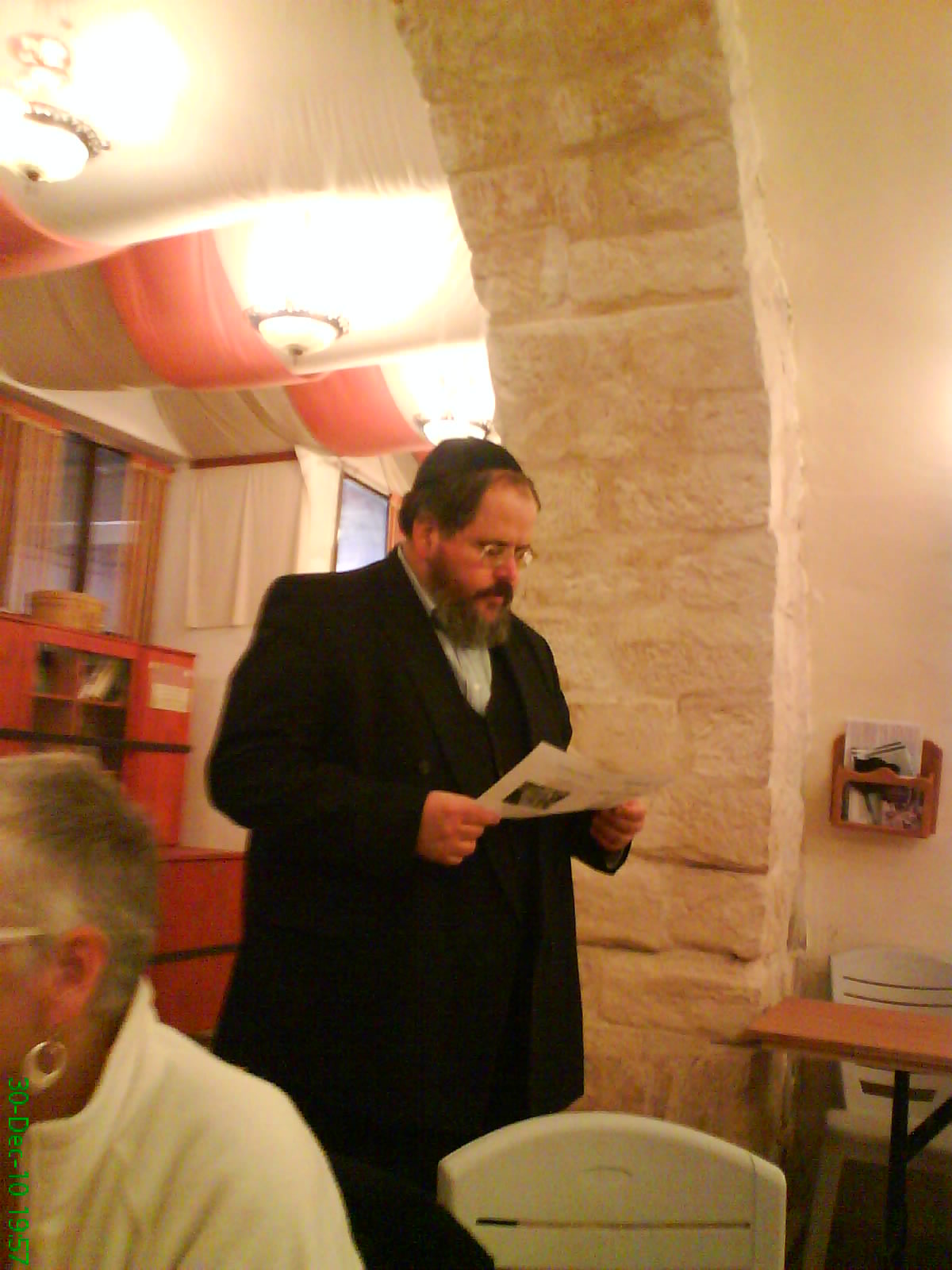
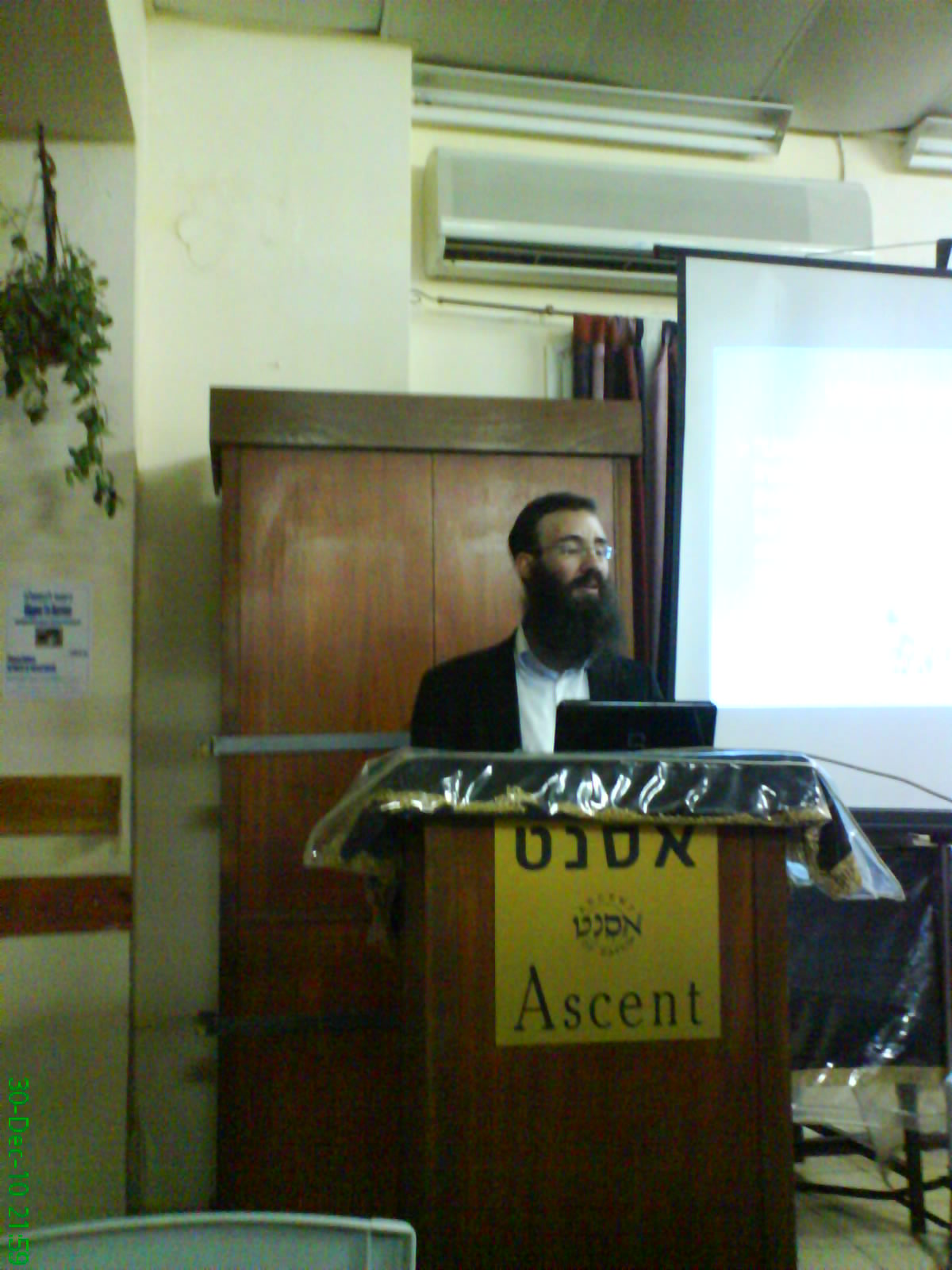
Rabbi Mordechai (Big Mo) Siev is welcoming the seminar participants.


Rabbi Yerachmiel Tilles (at the end of the table with the long white beard) gave a brief religious introduction.


Dr. Gil Shachar, our lecturer.


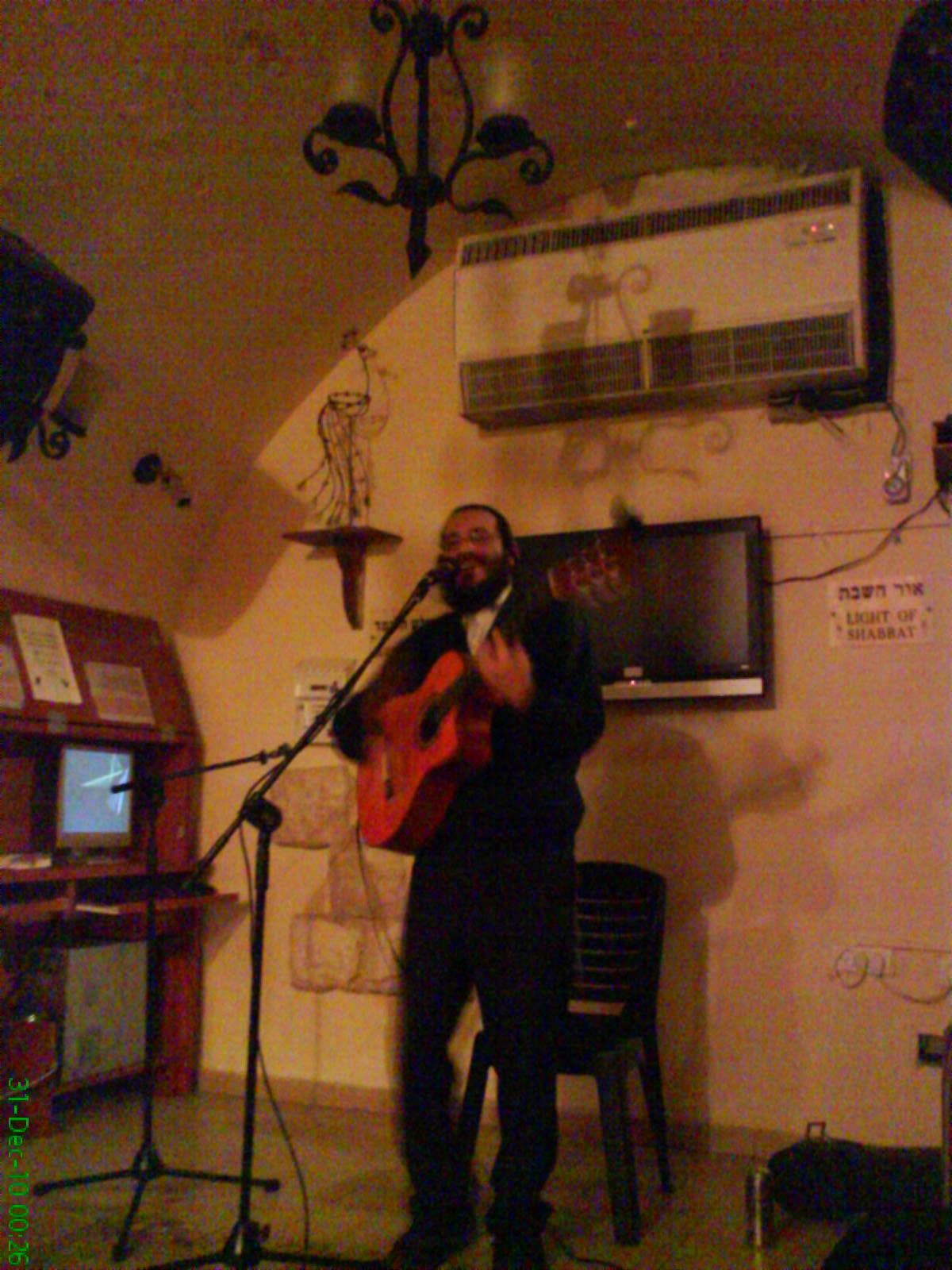
Afterwards the first lectures we were invited to a "spiritual" concert with a Breslover Chassid from the chassidic Zfat band "Simply Zfat".


Despite all lectures on health and the right nutrition: At the concert beer, potatoe chips and other junk food were served.

I am going to translate Dr. Shachar's lectures as soon as I can

Photos: Miriam Woelke

LATMA versus PEACE NOW

B"H

The brandnew video of Israel's satire group LATMA. This time, they are making fun of Israel's extreme right wingers - the "PEACE NOW - SHALOM ACHSHAV" organization which should rather have its headquarter in Gaza than in Tel Aviv. 


Sunday, January 2, 2011

Getting dark in Zfat (Safed) / Northern Israel


Photos / Copyright: Miriam Woelke

"The War against the Jews" by Dagobert D. Runes


B"H

"The War against the Jews" by Dagobert D. Runes is an extraordinary book every Jew should read.The author lists how the Church has always been trying to destroy the Jew. A status quo we have until today. Let alone all those vicious Christian missionaries creeping around and spreading their idol - worship. 

Runes himself calls his book "A Book of War". The war of the Christian Churches against the Jews. 

I am planning to publish some content from the book. Facts, everyone should be aware of and don't sweap it under the "carpet of history". 

The Catholic church, for instance, sees in Augustine (354 - 430) a saint. Augustine was the bishop of Hippo and the most influential Catholic theologian. He called Judaism a "corruption". The true image of the Hebrew is Judas Ish Kariot, who sells J. for silver. The Jew can never understand the Scripture and forever will bear the guilt for the death of J.

In the judgment of this fountain of Christian love, the Jew must forever spend his life as a slave.
______________________________

Just a brief personal remark on this hateful opinion: 
Those who do not understand are those Gentiles who are not Noachides. The task of every Gentile is to follow the Seven Noachide Laws and not a self - created piece of idol - worship coming from a dead Jew.

REINCARNATIONS in Talmud & Prayer

B”H


Exhibited Kabbalah picture in Zfat.

Photo: Miriam Woelke


Just recently I wrote about REINCARNATIONS and that the whole concept is part of Judaism. 

Reincarnations as well as further kabbalistic teachings such as the “Sefirot” (Keter, Chochmah – Wisdom, Bina – Understanding, etc.) are anything but an invention of some Jewish medieval Kabbalists. Those ideas have been already put down in the Talmud and great Rabbis such as Rabbi Akivah were very much aware of the secret teachings of the Torah. 

This is what KABBALAH is: The hidden content in the Torah. Content which is not revealed to us unless we learn it with a teacher (a Rabbi). 

Kabbalah is being divided into two levels:

  1. The Theoretical Kabbalah
  2. The Practical Kabbalah.

Once again, Rabbi Akivah knew very well how to use the practical Kabbalah. Just look at the Talmudic story when he and his friends went into the “Pardes” where only Rabbi Akivah himself came out. The others either died, lost their minds or became totally secular. Meaning that one has to be on an extremely high level in order to deal with the practical Kabbalah. 

Moreover, in order to deal with the Jewish Kabbalah, one must be Jewish, as the Jewish soul is involved. A Gentile with a non – Jewish soul is unable to connect to Jewish Kabbalah. Rabbi Yitzchak Luria already refers to this in his days and if Madonna was learning his real writings then she may come to the conclusion that her studying Jewish Kabbalah is nothing but in vain.

It is also said that it was Rabbi Akivah hiding the practical Kabbalah, as too many people started using it for evil negative purposes. As far as we know, the false Christian Meshiach, the Jew J., was one of those using the Kabbalah for his own purposes and not for the good. 

Furthermore, we learn from prayer that there are reincarnations in Judaism. Look into the “Bedtime Shema - Kriat Shema la’Mitah” – first paragraph “Ribono shel Olam”.
Every night before we go to bed, in “Ribono shel Olam” we forgive other people for treating us not that nicely on this particular day. 

“Master of the Universe ! I hereby forgive anyone who has angered or vexed me, or sinned against me, either physically or financially, against my honour or anything else that is mine, whether accidentally or intentionally, inadvertently or deliberately …

… bejn be’shogeg bejn be’mesid bejn be’dibur bejn be’ma’aseh bejn be’GILGUL (REINCARNATION) zeh bejn GILGUL acher

There are Jews who undergo different reincarnations and should not be punished for their wrongdoings against me in this reincarnation and not in the next.

Saturday, January 1, 2011

"Shavua Tov - Have a great new Week !"

B"H

Shabbat is over and I have to say that the Chabad hostel ASCENT in Zfat made a huge effort to "entertain" us. Not only with the "Healing Seminar with content according to the Rambam" but the entire Shabbat programme. 
No, we didn't get brainwashed by Chabad although it was mentioned plenty of times that Friday was the Yahrzeit of Rabbi Shneur Zalman of Liadi.

We had great meals together some teachings (general and not only Chabad !) and we, of course had a good LeChaim: Vodka and Jack Daniel's. 

Most of the Shabbat I spent in my favourite place - the library. However, here are some photos from before and after Shabbat at Ascent. Tomorrow I am going to write about the seminar, including healthy nutrition according to the Rambam !


Before Shabbat: One of the two Ascent founders, Rabbi Shaul Leiter, gave a lecture on the kabbalistic holiness of Zfat. 

The participants in the Shabbat programme usually come from all kinds of ages, countries and religious backgrounds. We had quite a few conservative Americans who enjoyed the programme but will remain conservative. 


At the Havdalah Service


Ascent frequently has soldier's groups coming in. The Ascent philosophy is that Israeli soldiers have to know for what they fight. They have to know about the importance of Hebron, for instance. 


Also the girls were dancing: behind the Mechitzah !

Photos: Miriam Woelke